


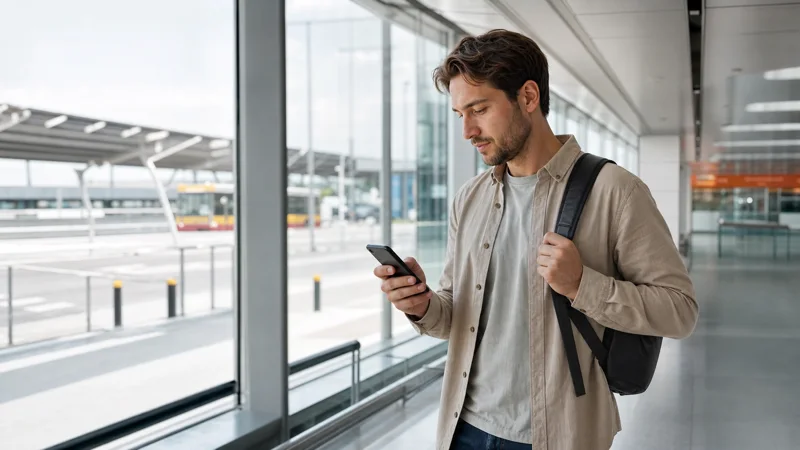

The most dependable way to have internet at Warsaw Airport is to prepare a Poland eSIM before departure and keep offline arrival details. Airport WiFi, a registered local SIM and home roaming can also work, but they involve different security, setup and cost considerations.
This article follows the established airport connectivity workflow and avoids fixed claims about shop hours, transport schedules or temporary offers. Check official airport, transport and plan information immediately before travel.
NoveSIM travel eSIM plans are data-only and normally do not include a Polish telephone number, traditional calls or SMS. Internet messaging, navigation and app-based calling continue to work through the mobile-data connection.
Quick answer: Prepare an unlocked compatible phone, mobile data and offline documents before departure. After landing, use verified services, protect the home SIM from accidental roaming and test the connection before leaving the terminal.
Top Poland eSIMs

Poland eSIM
Fixed
1 GB, 7 days€ 1.772 GB, 15 days€ 3.553 GB, 30 days€ 4.44Unlimited
Unlimited, 1 day€ 2.22Unlimited, 3 days€ 4.88Unlimited, 5 days€ 7.99
Europe Extra eSIM
Fixed
1 GB, 7 days€ 2.222 GB, 15 days€ 3.553 GB, 30 days€ 4.44Unlimited
Unlimited, 1 day€ 2.66Unlimited, 3 days€ 5.32Unlimited, 5 days€ 8.87Europe+ eSIM
Fixed
1 GB, 7 days€ 2.662 GB, 15 days€ 3.993 GB, 30 days€ 5.32Unlimited
Unlimited, 1 day€ 2.66Unlimited, 3 days€ 6.21Unlimited, 5 days€ 10.20Choose an arrival connection that continues beyond the terminal
Airport WiFi can help inside public areas, but it ends when the traveller leaves the building. Mobile data continues through the airport-to-city transfer and supports accommodation messages, live maps and transport updates. This continuity is the main reason to prepare a travel plan.
A local Polish SIM can provide a domestic number, but prepaid service requires registration. Shop availability and current tariffs can change, so a late-arriving tourist should not make a specific airport seller the only connection plan.
Home roaming is operationally simple but financially dependent on the home provider’s current Poland zone and fair-use rules. Review data, calls, SMS and voicemail rather than assuming that one roaming label covers every service.
A preinstalled eSIM is normally the lowest-friction data choice for an unlocked compatible phone. NoveSIM plans are data-only, so they support internet apps rather than a Polish telephone number or traditional voice service.
A connection plan from landing to the Warsaw hotel
Before departure, save the accommodation address, booking instructions and a current airport-to-city route offline. Install the eSIM on trusted WiFi and label it Poland, but follow the plan’s exact activation timing.
After landing, enable the travel line, select it for mobile data and apply its required roaming setting. Keep roaming and automatic data switching off on the home line unless that line’s use is deliberate.
Test a browser page, map search and data-based message in the public arrivals area. Then verify that cellular usage belongs to the Poland line. Signal bars alone do not prove that the correct SIM is carrying data.
Before leaving, check battery level and the next transfer step. A power bank or charging cable is valuable because navigation and network registration can consume power during the first journey.
Airport connectivity options compared
| Option | Main advantage | Important check |
|---|---|---|
| Travel eSIM | Install before departure | Compatibility, validity and partner network |
| Local prepaid SIM | May include a Polish number | Registration, seller and current package |
| Home roaming | No new profile | Poland zone, fair-use data and charges |
| Airport WiFi | Temporary terminal access | Official network, security and coverage limit |
Pre-departure checklist
- Confirm the exact phone model supports eSIM and is carrier unlocked.
- Choose a plan whose validity covers arrival through departure.
- Install on trusted WiFi and label the line Poland.
- Save the QR code and manual details privately.
- Download maps, tickets and accommodation information.
- Carry sufficient battery power for the arrival transfer.
Compare current plans on the Poland eSIM page. Use the compatible-device guide and the NoveSIM setup overview before purchase.
Correct arrival settings
- Disable Airplane Mode and enable the Poland eSIM.
- Select it for cellular data.
- Enable roaming on that travel line when required.
- Keep home-line roaming and automatic data switching off.
- Leave network selection automatic.
- Test a webpage, map and data-based message.
Travel eSIM roaming is normal because the profile uses a partner network. The prepaid travel allowance governs its data use, while calls or messages on the home line remain subject to the home provider’s tariff.
Public WiFi safety
Verify the network name through current official information or staff. Avoid unexpected profiles, certificates and applications. Prefer encrypted websites and do not perform sensitive account changes on an unverified network.
Forget public WiFi after use and disable automatic joining. Airport coverage ends outside the terminal, so a tested mobile line or offline route is still necessary for the onward journey.
Never expose an eSIM QR code, manual activation value or order reference on a public screen or forum. Contact the provider through its official support channel.
Data and battery management after arrival
Reset cellular statistics after the first test and review them at the accommodation. Pause cloud photo backup, app updates and operating-system downloads on mobile data.
Use trusted hotel WiFi for large transfers. Mobile data should remain available for navigation, live travel changes and communication between venues.
Continuous navigation and weak-signal searching consume battery. Keep a charging cable or power bank available and lower unnecessary screen brightness.
Troubleshooting without deleting the eSIM
- Confirm the profile is enabled and selected for data.
- Check roaming, validity and remaining allowance.
- Toggle Airplane Mode once and restart the phone.
- Compare the APN with the supplied value.
- Test in an open public location.
- Contact support with screenshots before deletion.
Some profiles cannot be reinstalled after activation. The NoveSIM FAQ provides additional general help. Preserve the installed profile while support reviews the settings.
The first 24 hours after arrival
Keep the accommodation address and check-in instructions offline. Send an estimated arrival time while the connection is stable, especially for a late check-in.
Before the first sightseeing day, download attraction tickets and the relevant map area. Historic walls, underground sections and crowded venues can create local reception changes.
Review data use and remaining validity before sleep. Correct an unintended home-line data assignment early and pause background activity that does not need to occur on cellular.
When travelling with companions, make sure each person knows the accommodation and a meeting point. One shared hotspot makes the group dependent on the host phone’s battery and location.
Plan internet around a Warsaw arrival, not just the terminal
Warsaw is often the first stop in a longer Polish itinerary, so the arrival connection should cover more than the first ride into the centre. Keep the hotel address, reservation number and first transport choice available offline, then use live data to confirm the current route. If the trip continues by intercity train, save the station name and departure details as well; Warsaw has several rail stations, and a generic instruction to go to “the station” is not precise enough.
Late arrivals need a particularly independent setup. Reception desks, transport frequency and retail availability may differ from daytime conditions. A working mobile line lets the traveller notify accommodation, compare a current route and request help without searching for an open shop. It still makes sense to retain an offline fallback because a flat battery or a temporary indoor signal gap can affect any network.
Families should decide before landing whether every phone needs its own plan. A hotspot can connect a second device for a short task, but it makes the group dependent on one handset’s allowance, battery and physical location. Separate connections are more resilient when travellers split up, collect baggage at different times or use different transfers.
Business travellers should test the actual tools needed after arrival rather than assuming that ordinary browsing proves everything. Sign-in systems, authentication applications, company VPNs and conference tools may have separate requirements. Complete large downloads on trusted WiFi and preserve cellular data for navigation and time-sensitive communication.
Review the connection before the return to Warsaw Airport
Do not treat departure day as outside the data plan. Check the remaining allowance and validity the evening before the flight, download the boarding pass, and save the route to the correct terminal area. Leave enough battery for ticket inspection, airline messages and last-minute transport changes.
Keep the Poland eSIM active until the airport journey is complete. If the home line will become the data line after the flight, switch it only when the normal tariff is appropriate. Removing the travel profile early offers no practical benefit and can make later troubleshooting or reuse impossible.
Related Articles
FAQ
Should I install a Poland eSIM before flying?
Usually yes. Trusted WiFi and time to resolve installation issues make pre-departure setup preferable.
Does a travel eSIM provide a Polish number?
NoveSIM travel plans are data-only and normally do not include a local number, traditional calls or SMS.
Can I rely only on airport WiFi?
It can help inside the terminal, but mobile data and offline documents provide continuity after leaving.
Should roaming be enabled?
Travel eSIMs commonly require roaming on the eSIM line. Keep it off on the home line unless intended.
Should I delete an eSIM that does not connect?
No. Refresh the supported settings and contact support before deleting an installed profile.
Final recommendation
Prepare mobile data and offline documents before flying. Use airport WiFi as a supplement, then rely on a tested Poland eSIM or another deliberate mobile option for the complete transfer into Warsaw.
Recheck current airport, transport and plan information before departure because operational details can change.