


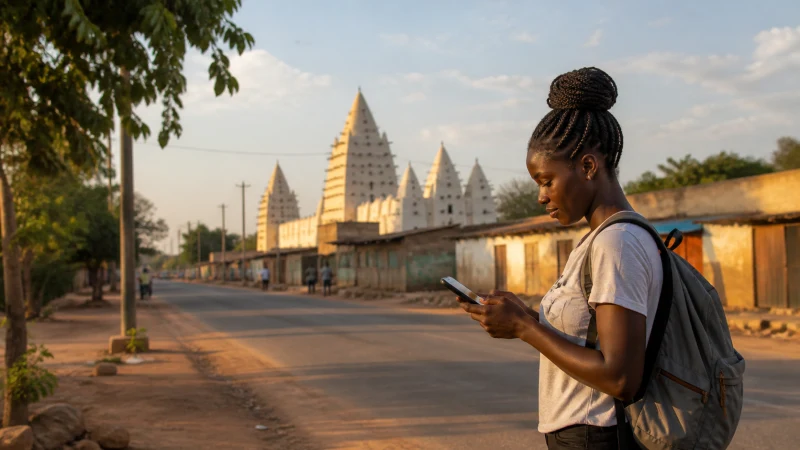

Wa, capital of the Upper West Region, sits in the most remote corner of Ghana, within reach of both the Burkina Faso and Ivory Coast borders, and sees fewer visitors than any other regional capital in the country. It’s known for its distinctive Sudanese-Sahelian style mosques and a slower pace than almost anywhere else in Ghana.
Quick answer: Wa has the thinnest regional-capital coverage in Ghana — workable 4G in the town center, but noticeably less consistent than Bolgatanga, Tamale, or any city further south. Anyone traveling here should arrive with connectivity already set up and treat much of the surrounding region as offline territory.
Top Ghana eSIMs

Ghana eSIM
Fixed
1 GB, 7 days€ 9.332 GB, 15 days€ 16.003 GB, 30 days€ 21.33Unlimited
Unlimited, 1 day€ 8.44Unlimited, 3 days€ 22.66Unlimited, 5 days€ 36.43
Coverage in central Wa
The town center maintains functional 4G from Ghana’s main networks, adequate for basic messaging and browsing, though it’s genuinely the least dense coverage among Ghana’s regional capitals — a direct reflection of the Upper West Region’s low population density and its distance from the country’s main infrastructure investment.
Which network to use in Wa
MTN’s broader rural investment across northern Ghana generally gives it an edge here too, though it’s worth setting expectations lower than in Tamale or Bolgatanga — even MTN’s coverage in this region doesn’t match what’s available further south or along the coast.
Wa’s distinctive mosque architecture
The Sudanese-Sahelian style mosques that draw architecture-interested visitors to Wa sit within the town itself, so coverage while visiting them is in line with the rest of central Wa — reasonably workable, if not fast, and sufficient for looking up background information or sharing photos.
Near the Burkina Faso and Ivory Coast borders
Wa’s position near two international borders means coverage in the surrounding countryside can be genuinely sparse, and travelers exploring toward either border should expect extended stretches with no signal at all — the manual network selection guide is worth reviewing in case your phone registers on a foreign network near either crossing, though the bigger challenge here is often no signal at all rather than the wrong signal.
Why Wa sees so few visitors
Wa and the wider Upper West Region sit at the furthest possible remove from Ghana’s established tourist circuit, and the region’s connectivity infrastructure reflects that low visitor volume as directly as anywhere in the country — this isn’t a criticism so much as a straightforward consequence of geography and population density.
Getting connected before you arrive
Given how limited local options are this far from Ghana’s more developed south, arriving with a SIM or eSIM already active from Accra or Kumasi is essentially a requirement rather than a suggestion — the best SIM card guide covers network selection with this kind of remote travel specifically in mind.
Planning around limited coverage
Downloading offline maps and any information you’ll need well before reaching Wa, covered in the Google Maps in Ghana guide, matters more here than almost anywhere else in the country, given how genuinely limited connectivity becomes once you leave the town center.
FAQ
Is mobile coverage reliable in Wa?
Workable in the town center, but the thinnest among Ghana’s regional capitals.
Which network is best in Wa?
MTN generally has an edge given its rural investment, though expectations should be lower than elsewhere in the north.
Will I have signal near the Burkina Faso or Ivory Coast borders?
Often not — expect genuinely sparse coverage rather than just a wrong-network issue.
Should I set up connectivity before reaching Wa?
Yes, essential given how limited local options are this far from southern Ghana.
Is there coverage at Wa’s famous mosques?
Yes, they sit within the town itself with coverage in line with central Wa generally.
Should I download offline maps before visiting Wa?
Yes, more so than almost anywhere else in Ghana, given how limited coverage becomes outside town.
Final Recommendation
Wa represents Ghana’s most limited regional-capital connectivity — arrive fully prepared with a working SIM or eSIM and offline maps rather than expecting to sort anything out locally. See the rural mobile coverage guide for the broader pattern this fits into.