


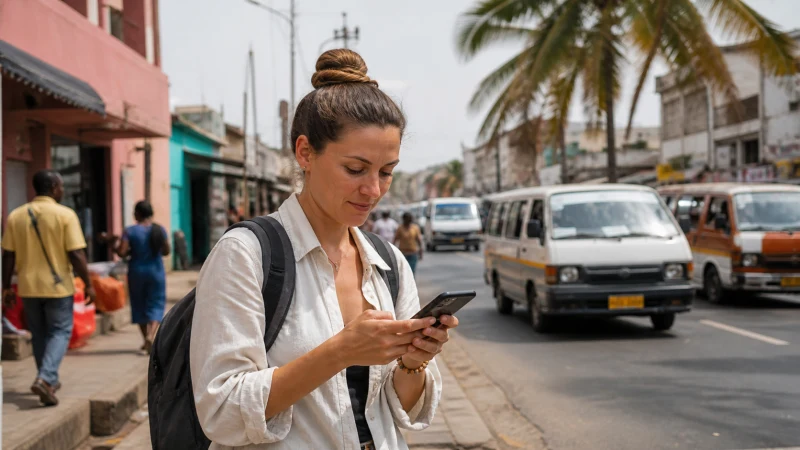

Ghana is one of West Africa’s more connected countries, with a mobile market shaped by three national networks and a mobile money culture that touches almost everything, from topping up data to paying a taxi fare. For a first-time visitor, the practical questions are simple enough: which network to use, how to get data set up quickly after landing, and what changes once you leave Accra for the coast, the north, or a national park.
Quick answer: Expect strong 4G in Accra, Kumasi, and most regional capitals, with MTN generally offering the widest reach, including into rural areas. Get a local SIM at Kotoka International Airport or in the city, or install an eSIM before you fly if you’d rather skip registration and start connected the moment you land.
Top Ghana eSIMs


Ghana’s three mobile networks
MTN Ghana is the country’s largest network by a clear margin, with the deepest reach into smaller towns and rural districts. Telecel Ghana (the operator formerly known as Vodafone Ghana, rebranded after a change in ownership) and AirtelTigo round out the market, both performing well in cities and along the main highway corridors but generally with a narrower rural footprint than MTN. The mobile networks in Ghana guide covers how the three compare in more detail.
Coverage in the major cities
Accra, Kumasi, and Ghana’s other regional capitals all have dense 4G coverage from every major network, more than sufficient for maps, messaging, video calls, and everyday browsing. The internet in Accra guide and internet in Kumasi guide cover the country’s two biggest cities specifically, including neighborhood-level detail that a national overview like this one can’t get into.
What changes outside the cities
Coverage thins out the further you get from a regional capital or major highway, and rural Ghana follows a pattern common across the region — solid signal in and around towns, patchier coverage on unpaved roads and in more remote farming districts. The rural mobile coverage guide covers what to expect if your trip includes destinations off the main tourist circuit.
4G, 5G, and realistic speed expectations
4G is the standard experience across Ghana’s cities and large towns, generally fast enough for streaming, video calls, and navigation without much frustration. 5G exists only in early, limited form in parts of Accra as of this writing, and isn’t something to plan a trip around — the 4G and 5G in Ghana guide covers where things currently stand and how quickly that’s likely to change.
Getting connected: airport, city, or before you fly
Kotoka International Airport in Accra has SIM kiosks in the arrivals area for MTN, Telecel, and AirtelTigo, all requiring a passport for registration — the Kotoka Airport SIM guide covers exactly what that process looks like. If you’d rather arrive already connected, installing an eSIM before departure means skipping the kiosk altogether, and the local SIM vs eSIM guide covers which approach suits different kinds of trips.
Mobile money and data top-ups
Mobile money, led by MTN Mobile Money, is deeply embedded in everyday transactions across Ghana, and it’s also the most common way locals top up data bundles — worth knowing even as a visitor, since some SIM top-up processes lean on this system rather than a simple card payment. The mobile data in Ghana guide covers how bundles are typically bought and renewed.
WiFi as a supplement
Hotels, cafes, and coworking spaces in Accra and other larger cities generally offer WiFi as a backup to mobile data, though given how solid and affordable mobile coverage is in the cities, most visitors lean on their SIM or eSIM far more than any WiFi network. The Ghana lodge internet guide covers what to expect at accommodation outside the main cities specifically, where WiFi becomes considerably less consistent.
Using Ghana as a base for wider travel
Many visitors combine Accra and Kumasi with a coastal trip to Cape Coast’s forts and Kakum National Park’s canopy walkway, or venture north toward Tamale and Mole National Park for wildlife. The Ghana road trip guide covers connectivity planning for a longer circuit, since coverage along the routes between these regions varies more than it does within any single city.
FAQ
Is mobile coverage reliable throughout Ghana?
Yes in the cities and along main routes — Accra, Kumasi, and other regional capitals all have strong 4G, though rural areas and remote roads see more variable coverage.
What speeds can I expect in Ghana?
4G in the cities is generally fast enough for streaming and video calls without issue; 5G remains limited to small pockets of Accra.
Which network should I choose as a tourist?
MTN is the safest default given its rural reach, though Telecel and AirtelTigo both perform well in cities — the best network guide covers the specifics.
Should I get a SIM at the airport or install an eSIM before I fly?
Both work well — the airport is convenient right on arrival, while an eSIM means skipping the kiosk and passport paperwork entirely.
Do I need mobile money as a tourist?
Not strictly, but it’s worth knowing it exists, since some data top-up processes in Ghana lean on it rather than a straightforward card payment.
Is Ghana a good base for exploring West Africa’s coast and national parks?
Yes — Cape Coast, Kakum, and Mole National Park are all reachable from Accra or Kumasi, though coverage becomes more variable the further you travel from the main cities.
Final Recommendation
Ghana offers dependable connectivity in its cities, with MTN the strongest all-round choice if your trip extends beyond Accra and Kumasi. Get set up with a local SIM or eSIM early in your visit, and check the best way to get internet in Ghana guide for a fuller comparison of your options before you decide.