


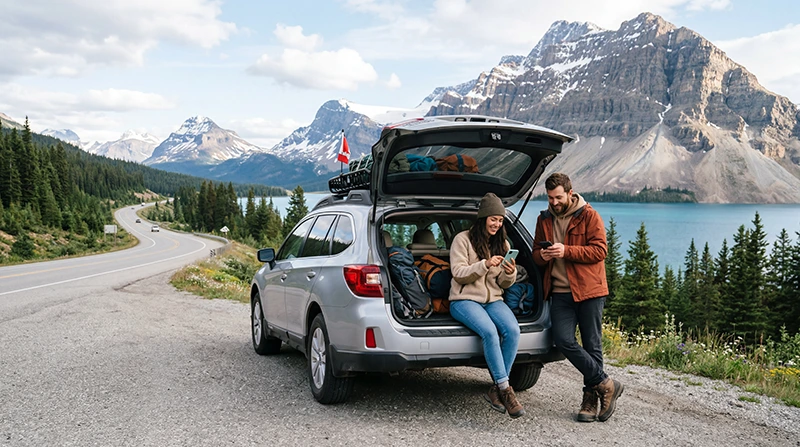

A Canada road trip can move from strong city coverage to long sections where the phone has only a weak signal or none at all. The right internet setup therefore depends on the roads, parks and overnight stops in your itinerary—not simply on whether a plan says that it covers Canada.
Mobile data is useful for navigation, accommodation messages, fuel searches and current road or weather information. It should support the journey, but it should never be the only place where you keep directions, essential contacts or booking details.
NoveSIM travel eSIMs are data-only. We do not provide a Canadian phone number or conventional calls and SMS with these plans; internet calling and messaging apps can work when mobile data is available.
Quick answer: Check the permitted Canadian networks against every important road leg before choosing a plan. Install the eSIM before departure, test it while you are still in a populated area, and download maps, accommodation addresses, fuel stops and official route information for offline use. Expect possible gaps on remote, mountain and park roads, even when the wider region appears covered.
Top Canada eSIMs

Canada eSIM
Fixed
1 GB, 7 days€ 4.022 GB, 15 days€ 6.703 GB, 30 days€ 9.83Unlimited
Unlimited, 1 day€ 5.36Unlimited, 3 days€ 15.19Unlimited, 5 days€ 23.69
Plan the Connection Road by Road
National coverage percentages are too broad for a driving itinerary. A weekend between Toronto and Ottawa, a route through the Rockies and a northern journey all place different demands on a mobile connection. Start with the roads you will actually use, including detours and the return journey.
Break the trip into practical legs and prepare a backup for each one:
| Road-trip leg | What you may need online | What to keep offline |
|---|---|---|
| Airport to first accommodation | Navigation, check-in messages and parking instructions | Full address, booking reference and first route |
| City-to-city drive | Traffic, road updates and revised arrival time | Main route, one sensible alternative and fuel stops |
| Park or mountain section | Current conditions where service is available | Complete map, entry details and the planned exit point |
| Rural overnight stop | Property contact, food and local services | Check-in instructions, address and nearby essentials |
| Ferry or remote connection | Operator updates and onward directions | Reservation, timetable and boarding location |
For every significant leg, compare the plan’s permitted partner networks with their current coverage maps. The Canada network guide explains what to compare. Coverage maps are planning tools rather than promises: terrain, buildings, congestion, weather, the phone and local network conditions can all affect the connection you receive.
Choose a Plan for the Itinerary, Not the Largest Allowance
A large data package is not automatically the best road-trip choice. First confirm that Canada is included, the validity covers the final driving day and the permitted networks are relevant to the planned route. Then compare the data allowance, activation rules, hotspot permission and any fair-use conditions shown for the exact package.
Navigation and messaging are usually lighter activities than video streaming, continuous photo backup or using a laptop through a hotspot. Estimate the trip by activity with the Canada data guide, and reserve some allowance for route changes or an unplanned extra day.
Open the current options on the Canada eSIM page before buying. Partner networks, 4G or 5G availability, hotspot use and connection speed depend on the selected plan, compatible device, location and local coverage. Do not assume that every package has identical terms.
Prepare the Phone Before the First Drive
Complete the installation while you have stable internet and enough time to resolve a compatibility or carrier-lock issue. A roadside stop is the wrong place to discover that the phone cannot install an eSIM.
- Confirm that the device supports eSIM and is carrier-unlocked.
- Choose the package only after checking its networks, validity, allowance and activation rule.
- Follow the supplied installation instructions and keep the QR code and order details private.
- Give the new line a clear label, such as Canada travel data.
- Turn off data roaming for the home SIM if you want to avoid accidental roaming charges.
- After arrival, select the Canada eSIM for mobile data and enable Data Roaming on that line when the package requires it.
Installation does not always start the plan’s validity, but the activation rule varies. Follow the instructions supplied with the purchased package rather than relying on a general assumption. The Canada installation guide provides the complete preparation sequence.
Test the Connection Before Leaving the City
Do not treat a signal icon as a complete test. Switch off Wi-Fi, confirm that the travel eSIM is selected for mobile data, open a normal webpage, load the next route and send a message. Test any permitted hotspot function before you depend on it for another device.
Automatic network selection is usually the best starting point while driving between regions. If the eSIM does not register where coverage is expected, confirm that the plan is active and Data Roaming is enabled on the travel line. For NoveSIM, the APN is data.esim when manual entry is required.
Keep the installed eSIM on the phone during normal troubleshooting. Do not delete it unless NoveSIM support specifically instructs you to do so. The ordered checks in the Canada eSIM troubleshooting guide can help distinguish a settings problem from a temporary coverage gap.
Build an Offline Pack for Every Driving Day
Download the relevant map area before leaving a reliable connection, and verify that the route remains visible in offline mode. A screenshot of one route is not enough if a closure or missed turn forces you to change direction.
Save the following details directly on the phone:
- the day’s route and at least one realistic alternative;
- the next accommodation address and check-in instructions;
- planned fuel or charging stops, especially on longer rural legs;
- reservation details for ferries, parks or timed entries;
- roadside assistance and essential local contact information;
- the official road, weather or park information relevant to that province and route.
Check current information shortly before departure because road access, wildfire conditions, severe weather, ferry operations and park restrictions can change. Use the responsible authority for the province, park or transport service involved rather than an old screenshot or an unverified travel post.
Expect Coverage Gaps on Remote and Mountain Roads
An eSIM can connect only where one of its permitted networks provides usable service. It cannot create reception beyond the network, and it cannot guarantee coverage in wilderness areas, deep valleys, mountain passes or sparsely populated stretches.
If a route authority, park service or activity provider advises an independent emergency communication method, follow that guidance. Mobile data is not a substitute for an emergency plan, appropriate equipment or a satellite communicator where the journey genuinely calls for one.
Tell someone the route and expected arrival time when travelling through a long low-service section. Keep enough fuel, battery power and offline information to complete the leg without a live connection. A charged power bank is particularly useful when navigation and weak-signal searching increase battery use.
Use Wi-Fi as a Resupply Point
Trusted accommodation Wi-Fi can be useful for refreshing large offline maps, downloading media and backing up photos. Public Wi-Fi availability and performance vary, so it should be a helpful extra rather than the only connection in the plan.
If you use a hotspot from the travel eSIM, check that the selected package permits it. Continuous tethering can consume both data and battery quickly. Download large files while parked and on a trusted connection; never handle the phone while driving.
Related Articles
- Compare current Canada eSIM plans
- Compare Canadian networks for your route
- Estimate data for a Canada trip
- Install a Canada eSIM before departure
- Troubleshoot a Canada eSIM
FAQ
What is the best way to get internet on a Canada road trip?
Choose an eSIM or SIM whose permitted Canadian networks fit the roads and stops in your itinerary. Check validity and data allowance, install before departure, test the line in a populated area and keep essential route information offline.
Will an eSIM work in Banff, Jasper and along the Trans-Canada Highway?
It may work where a permitted partner network has usable coverage, but service can vary along mountain, park and rural sections. Check the relevant network maps for each road leg and prepare to continue safely without a signal.
How much mobile data do I need for driving in Canada?
The answer depends on trip length and use. Navigation, messages and occasional searches generally need less data than streaming, cloud photo backups or hotspot work. Estimate those activities and choose validity that lasts through the final drive.
Should I download offline maps if I have a Canada eSIM?
Yes. Offline maps protect the journey when coverage weakens, a network is congested or the route enters a no-service area. Also save accommodation details, fuel stops and essential contacts outside online-only apps.
Final Recommendation
Choose internet for a Canada road trip by matching the plan’s permitted networks, validity and allowance to the actual roads, parks and overnight stops—not to a country-wide coverage claim alone.
Install and test the eSIM before the first long drive. Keep automatic network selection as the normal starting point, and retain the installed profile if a temporary gap or settings issue needs troubleshooting.
Download maps, addresses, fuel stops and current official route information before every remote leg. The most reliable road-trip setup combines useful mobile data with an offline plan that still works when the signal does not.