


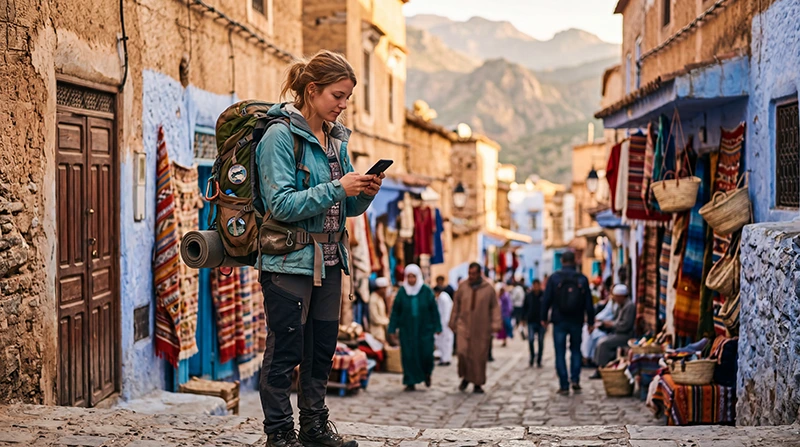

If you are backpacking in Morocco, internet is useful for Google Maps, WhatsApp, hostel bookings, riad messages, bus and train research, translation, taxis, emergency contacts and sharing travel updates.
Morocco has good mobile coverage in many cities and tourist areas, but coverage can become weaker in the Atlas Mountains, Sahara desert routes, rural valleys, remote beaches and long road sections. Backpackers should combine mobile data with offline maps and WiFi where available.
Quick answer: the easiest way to get internet while backpacking in Morocco is to install a Morocco travel eSIM before departure, use mobile data where coverage is available and download offline maps before remote routes.
Top Morocco eSIMs

Morocco eSIM
Fixed
1 GB, 7 days€ 3.552 GB, 15 days€ 5.773 GB, 30 days€ 7.99Unlimited
Unlimited, 1 day€ 4.44Unlimited, 3 days€ 11.54Unlimited, 5 days€ 18.64
Africa eSIM
Fixed
1 GB, 7 days€ 10.202 GB, 15 days€ 19.083 GB, 30 days€ 26.62Unlimited
Unlimited, 1 day€ 13.75Unlimited, 3 days€ 39.49Unlimited, 5 days€ 65.22Best Internet Options for Backpacking Morocco
| Option | Best For |
|---|---|
| Morocco eSIM | Main mobile data option for backpackers |
| Hostel, riad or hotel WiFi | Backup internet at accommodation |
| Local SIM card | Longer stays or local number needs |
| International roaming | Emergency use, often expensive |
| Offline maps | Essential backup for remote travel |
Why Backpackers Need Mobile Data in Morocco
- Navigate medinas, bus stations and train stations.
- Use WhatsApp with your existing number.
- Contact hostels, riads, tour guides and drivers.
- Book accommodation while moving between cities.
- Check bus, train and shared taxi options.
- Use translation apps and maps.
- Find restaurants, ATMs and cafés.
- Avoid expensive roaming data charges.
Expected Coverage for Backpacking Routes in Morocco
| Area or Route | Expected Mobile Coverage |
|---|---|
| Marrakech, Fes, Casablanca and Rabat | Very Good to Excellent |
| Chefchaouen and Tangier | Good to Very Good |
| Essaouira and Agadir | Good to Very Good |
| Marrakech to Ouarzazate | Variable in mountain sections |
| Fes to Merzouga | Good to Variable |
| Atlas Mountains | Variable to Limited |
| Sahara desert camps | Variable to Limited or Unavailable |
| Remote beaches and rural roads | Variable |
Important: eSIM Needs Mobile Coverage
A Morocco eSIM connects to local mobile networks. It does not provide satellite internet and cannot create signal where there is no mobile coverage.
This means mobile data can work well in cities, towns and many tourist routes, but may become weak or unavailable in remote mountains, desert camps, rural valleys and isolated coastal areas.
Morocco eSIM vs Local SIM Card for Backpackers
| Feature | Morocco eSIM | Local SIM Card |
|---|---|---|
| Buy before travel | Yes | No |
| Physical SIM needed | No | Yes |
| Works in remote areas without signal | No | No |
| Keep home SIM active | Yes | Depends on phone |
| Local phone number | Usually no | Usually yes |
| Best for short backpacking trips | Excellent convenience | Good if bought after arrival |
Internet in Moroccan Hostels and Riads
Most hostels, riads and guesthouses in major Moroccan cities offer WiFi, but quality can vary. WiFi may be strong in common areas and weaker in rooms, terraces or older medina buildings.
Mobile data is useful when hostel WiFi is slow, when you are moving between cities or when you need maps and WhatsApp outside your accommodation.
Internet for Backpacking Marrakech
Marrakech is one of the most popular backpacking stops in Morocco. Mobile data is useful for navigating the medina, finding your riad, contacting drivers, checking bus options and using WhatsApp.
Indoor signal can vary in some riads and narrow medina streets, so keep offline directions saved before arrival.
Internet for Backpacking Fes and Chefchaouen
Fes and Chefchaouen are popular with backpackers who want culture, medinas and mountain scenery. Mobile data helps with maps, accommodation messages and transport planning.
Coverage is usually better in town centers and main roads, but can vary in older buildings, narrow streets and mountain routes.
Internet for Backpacking the Sahara and Atlas Mountains
If your backpacking route includes Merzouga, Zagora, Erg Chebbi, desert camps or the Atlas Mountains, prepare for variable internet.
Download offline maps, save your camp or guesthouse contacts and send important messages before entering remote mountain or desert sections.
How Much Data Do You Need for Backpacking Morocco?
| Trip Type | Recommended Data |
|---|---|
| Weekend backpacking trip | 3–5 GB |
| One-week Morocco backpacking trip | 5–10 GB |
| Two-week Morocco backpacking trip | 10–20 GB |
| Backpacking with Sahara tour | 10–20 GB |
| Backpacking plus hotspot use | 20 GB+ |
| Heavy social media or video uploads | 20 GB+ or unlimited where coverage is available |
Typical Mobile Data Usage for Backpackers
| Activity | Approximate Usage |
|---|---|
| WhatsApp messages | Very Low |
| WhatsApp voice calls | 30–50 MB per hour |
| WhatsApp video calls | 250–500 MB per hour |
| Google Maps navigation | 5–10 MB per hour |
| Email and browsing | 50–150 MB per hour |
| Instagram browsing | 100–300 MB per hour |
| TikTok or Reels | 500 MB–1 GB per hour |
| YouTube HD | 1–3 GB per hour |
Recommended Phone Settings for Backpacking Morocco
| Setting | Recommended Value |
|---|---|
| Mobile Data | Morocco eSIM |
| Calls | Primary SIM |
| SMS | Primary SIM |
| Data Roaming on eSIM | ON |
| Data Roaming on Primary SIM | OFF |
| Automatic Data Switching | OFF |
| Network Selection | Automatic |
| APN | data.esim if required |
APN Settings for Morocco Backpacking eSIM
Most phones configure APN settings automatically. If mobile data does not work after arrival in Morocco, enter the APN manually.
| Field | Value |
|---|---|
| APN | data.esim |
| Username | Leave blank |
| Password | Leave blank |
| Authentication | None |
Offline Preparation for Backpacking Morocco
- Download offline Google Maps before leaving major cities.
- Save hostel, riad and camp addresses offline.
- Save bus, train and tour details.
- Screenshot booking confirmations.
- Save emergency contacts and travel insurance details.
- Charge your phone before long bus rides or desert tours.
- Carry a power bank.
- Send important messages before remote mountain or desert sections.
Can You Keep Your Home SIM Active?
Yes. Most modern Dual SIM phones allow you to keep your home SIM active while using your Morocco eSIM for mobile data where coverage is available.
- Use the Morocco eSIM for internet.
- Keep your home SIM for calls and SMS.
- Receive verification codes if supported by your home carrier.
- Use WhatsApp with your existing number.
- Avoid roaming data charges on your primary SIM.
Does WhatsApp Work While Backpacking Morocco?
Yes. WhatsApp works with mobile data or WiFi where internet access is available. Your WhatsApp account remains linked to your existing phone number, even if your Morocco eSIM is data-only.
In remote mountain or desert areas, WhatsApp may not work until you return to an area with mobile signal or WiFi.
Can You Use Hotspot While Backpacking Morocco?
Yes. Most smartphones allow hotspot sharing with an eSIM where mobile coverage is available. This can be useful for a laptop, tablet or another traveler.
Hotspot can use data quickly, especially with laptops, cloud sync, video calls and streaming. Choose a larger data plan if you plan to share your connection often.
How to Save Mobile Data While Backpacking
- Use hostel, riad or café WiFi for large uploads.
- Download offline maps before travel days.
- Turn off automatic photo and video backup.
- Disable automatic app updates on mobile data.
- Use lower video quality when streaming.
- Use WhatsApp voice calls instead of video calls when possible.
- Turn off background data for apps you do not need.
Common Internet Problems for Backpackers in Morocco
- Weak or unavailable signal in remote areas.
- Hostel or riad WiFi is slow or limited.
- Data Roaming is not enabled on the eSIM.
- The wrong SIM is selected for Mobile Data.
- Automatic Data Switching is turned on.
- APN settings are missing.
- Network Selection is set manually.
- The phone does not support eSIM.
What to Do If Internet Does Not Work
- Move to a more open area or closer to a town, road or accommodation.
- Check that the Morocco eSIM is turned ON.
- Select the Morocco eSIM for Mobile Data.
- Enable Data Roaming on the eSIM.
- Turn off Data Roaming on your primary SIM.
- Turn off Automatic Data Switching.
- Restart your phone.
- Turn Airplane Mode ON for 30 seconds, then OFF.
- Keep Network Selection on Automatic.
- Set APN to data.esim if required.
- Use hostel, riad, café or camp WiFi if available.
Related Morocco Backpacking Internet Guides
- Morocco eSIM
- Mobile Internet in Morocco
- Internet in Morocco for Tourists
- Best Way to Get Internet in Morocco
- Best eSIM for Morocco
- Local SIM vs eSIM Morocco
- Internet for Morocco Road Trip
- Internet for Atlas Mountains
- Morocco eSIM APN Settings
FAQ
What is the best internet option for backpacking Morocco?
For most backpackers, the easiest option is a Morocco travel eSIM combined with hostel WiFi and offline maps as backup.
Does eSIM work while backpacking Morocco?
Yes, a Morocco eSIM can work where supported local mobile coverage is available. It will not work in areas with no mobile signal.
Is hostel WiFi reliable in Morocco?
Hostel and riad WiFi can vary. It is often useful for basic browsing and messages, but mobile data is better when moving between cities or navigating outside.
How much data do I need for backpacking Morocco?
For one week, 5–10 GB is usually comfortable. For two weeks, Sahara tours or hotspot use, 10–20 GB or more is better.
Can I use WhatsApp while backpacking Morocco?
Yes. WhatsApp works with mobile data or WiFi where internet is available, and your account can stay linked to your existing number.
What APN should I use for Morocco backpacking eSIM?
If manual APN setup is required for a NoveSIM Morocco eSIM, use data.esim.
Final Recommendation
For most backpackers, the best internet setup in Morocco is a Morocco travel eSIM plus hostel WiFi and offline maps as backup. An eSIM is useful for maps, WhatsApp, hostel messages, transport planning, translation and travel updates across cities, mountains, beaches and desert routes.
Because coverage can vary in remote areas, install your eSIM before departure, enable Data Roaming after arrival, keep Network Selection on Automatic, download offline maps and use data.esim as the APN if manual setup is required.