


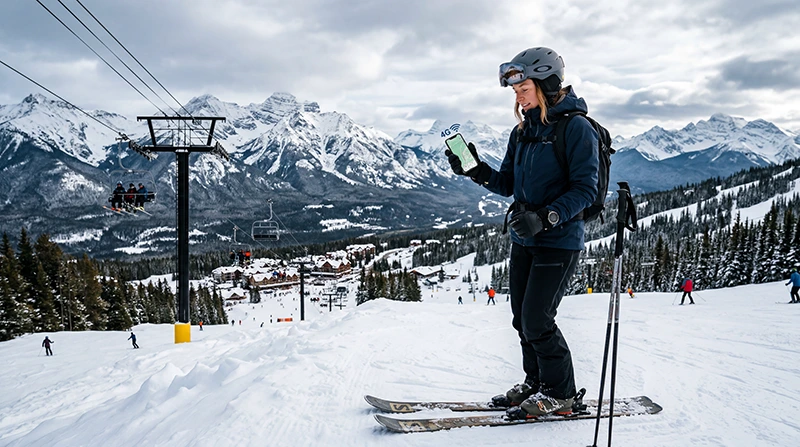

The best eSIM for skiing in Canada is not simply the plan with the largest data allowance. It is a plan that includes Canada, permits connection to networks that serve your chosen resort and travel route, and remains valid for the full trip.
A ski holiday can involve several different connectivity conditions: an airport or city, a mountain transfer, accommodation in the village and time on the slopes. A phone may connect well in one of those places and have limited or no usable signal in another.
NoveSIM travel eSIMs provide data only. They do not include a Canadian phone number or conventional calls and SMS, although messaging and internet-calling apps can work when a data connection is available.
Quick answer: Check the selected plan’s permitted Canadian partner networks against the resort, accommodation and road or transfer route—not just the nearest town. Choose enough validity and data for navigation, weather and resort apps, install before departure, and download essential tickets, maps and booking details for offline use. Do not rely on a travel eSIM as your only emergency communication method in mountain terrain.
Top Canada eSIMs

Canada eSIM
Fixed
1 GB, 7 days€ 3.962 GB, 15 days€ 6.613 GB, 30 days€ 9.69Unlimited
Unlimited, 1 day€ 5.28Unlimited, 3 days€ 14.97Unlimited, 5 days€ 23.34
Match the Plan to the Whole Ski Journey
Start with the exact itinerary. A flight into Vancouver followed by a transfer to Whistler is a different network test from a Calgary arrival followed by a drive towards Banff or Lake Louise. If the trip includes more than one resort, check every overnight stop and the roads between them.
Open the details of the specific package on the Canada eSIM plan page and note the networks it permits. Then compare those networks with their current coverage maps at the scale of your accommodation and route. A national coverage figure or a “5G” label cannot confirm reception at a particular lodge, lift or mountain road.
The Canada mobile-network guide explains why the useful network depends on the places you will visit. Remember that published maps are planning tools rather than guarantees: terrain, buildings, congestion, device capability and local conditions can affect the connection you actually receive.
Resort Village, Slopes and Transfer Roads Are Different
| Part of the trip | Likely data task | Preparation that matters |
|---|---|---|
| Airport and city | Transfer messages, accommodation details and navigation | Activate and test the travel line before leaving reliable service. |
| Road or coach transfer | Route changes, weather checks and arrival coordination | Save the route, operator details and destination address offline. |
| Resort village | Bookings, restaurant information, messaging and resort apps | Check both mobile coverage and the accommodation’s Wi-Fi terms. |
| Slopes and mountain terrain | Meeting companions and checking official updates | Agree a meeting point and time that do not depend on continuous signal. |
A resort name alone is too broad to answer the coverage question. The village may have service while a lift, valley, indoor area or road beyond it does not. Public Wi-Fi can be useful at accommodation or base facilities, but it does not replace mobile data during the transfer or guarantee a connection elsewhere on the mountain.
Choose Data for the Tasks You Will Actually Use
Maps, messages, email and occasional weather checks usually use less data than video, large cloud uploads or frequent hotspot use. Downloading resort maps and entertainment before travelling can keep the plan focused on useful trip tasks.
Before buying, check four package details:
- Validity: it should cover arrival, every ski day and the journey home.
- Data allowance: estimate navigation, messaging, resort apps and any work you genuinely expect to do.
- Hotspot terms: tethering availability depends on the purchased plan and device.
- Network and speed terms: partner networks, 4G or 5G availability and performance vary by plan, device, location and local coverage.
Use the Canada data-allowance guide to estimate the trip rather than selecting a plan only because it is described as large or unlimited. If you will cross into the United States, confirm that the chosen package covers both countries; a Canada-only plan does not automatically do so.
Install Before You Pack for the Mountain
Install the eSIM while you have a stable connection and enough time to read the instructions. Do not leave first-time installation until you are at a resort, where Wi-Fi may be busy, restricted or unavailable in your room.
- Confirm that the phone supports eSIM and is carrier-unlocked.
- Buy a plan that covers Canada and fits the dates, data needs and permitted networks for the itinerary.
- Follow the supplied installation instructions over reliable Wi-Fi, keeping the QR code and order details private.
- Label the new line clearly, for example Canada travel data, so it is not confused with the home SIM.
- Keep the home line selected for calls or SMS if needed, but prevent it from using roaming data if you want to avoid home-operator charges.
The Canada eSIM installation guide covers the preparation in more detail. Installation and activation are not always the same event, so follow the conditions for the exact plan you purchased.
Activate and Test Before the Mountain Transfer
After arriving in Canada, select the travel eSIM for mobile data and enable Data Roaming on that line if the package instructions require it. Leave the eSIM installed. Once it connects, load a simple webpage or map and send a message before leaving the airport or city.
If the line does not connect in a place where service is expected, check that:
- the purchased plan is active and includes Canada;
- the travel eSIM is selected for mobile data;
- Data Roaming is enabled on the travel line when required;
- the home SIM is not still selected for mobile data;
- automatic network selection has had time to register on a permitted partner network.
For NoveSIM, the APN is data.esim when manual APN entry is required. Do not delete the installed profile during ordinary troubleshooting unless NoveSIM support specifically tells you to do so. The Canada eSIM troubleshooting guide provides the safer diagnostic sequence.
Prepare for Gaps in Mountain Coverage
Mobile data is useful for official weather information, road conditions, transfer updates and meeting companions, but no eSIM can produce coverage where the underlying network has no usable signal. Cold conditions can also reduce phone-battery performance, so keep the device protected and carry an appropriate charged power source.
Before leaving a reliable connection:
- download the route and resort map;
- save lift-ticket or booking information in a form available offline;
- record the accommodation address and transfer contact details;
- check official resort, road and weather information;
- agree where and when your group will meet if phones cannot connect.
For a self-drive itinerary, use the Canada road-trip internet guide to plan the sections between towns and resorts. In remote or backcountry terrain, follow local authorities’ and the resort’s safety guidance and arrange an appropriate independent emergency plan; a data-only travel eSIM is not a substitute for that preparation.
Related Articles
- Compare current Canada eSIM plans
- Choose a Canadian mobile network for your itinerary
- Estimate mobile-data needs in Canada
- Prepare and install a Canada eSIM
- Plan internet for a Canada road trip
FAQ
Will a Canada eSIM work at every ski resort?
No. Availability depends on the plan’s permitted networks, the exact resort and route, terrain, buildings, device and current local conditions. Check the specific locations rather than relying on a country-level coverage claim.
Can I use an eSIM on the slopes?
You can use it wherever the phone can connect to a permitted partner network, but service may differ between the village, lifts, valleys and other mountain areas. Keep essential information offline and do not assume continuous coverage.
How much data do I need for a week-long Canada ski trip?
The answer depends on use. Navigation, messages and occasional official updates can require relatively little data, while video, cloud backups and hotspot use consume much more. Estimate those tasks and download large files before the trip.
Should I activate the eSIM before travelling to the resort?
Install it beforehand according to the plan instructions, then activate and test the data connection in Canada before leaving an airport or city with reliable service. This gives you time to correct settings before the mountain transfer.
Final Recommendation
Choose an eSIM for skiing in Canada by matching the purchased plan’s partner networks, validity and data allowance to the full journey: arrival airport, transfer route, accommodation and each resort.
Install before departure, activate and test the travel line before heading into the mountains, and keep the profile installed if troubleshooting is needed.
Save tickets, routes and essential contact details offline, agree a no-signal meeting plan, and treat mobile data as a useful travel tool rather than a guarantee of coverage or emergency communication in mountain terrain.