
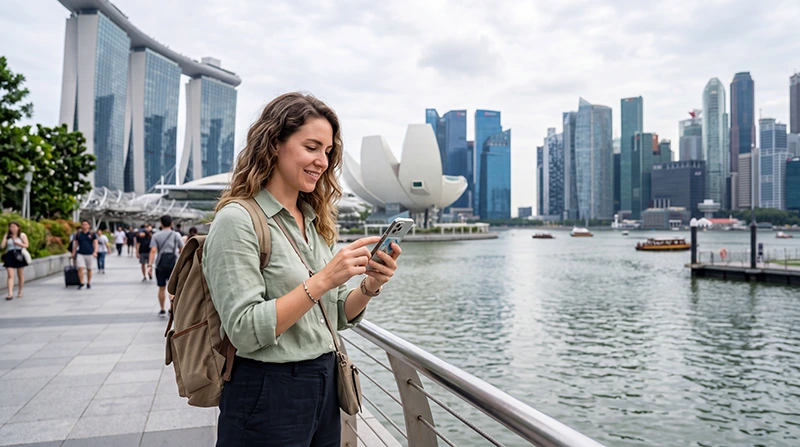

Tourist using mobile data in Singapore with eSIM while navigating Marina Bay, MRT and travel apps

How Much Data Do You Need for Singapore?

Choosing mobile data use in Singapore depends far more on streaming, video calls, cloud backups and hotspot use than on the number of travel days alone.

Check recent phone usage, remove Wi-Fi traffic from the estimate and add a margin for maps, bookings and unexpected itinerary changes.

A NoveSIM allowance covers mobile internet, while ordinary calls, SMS and verification messages continue through the line that owns the primary number.

Quick answer: Many travellers use about 500MB to 1GB per day when they combine maps, Grab, messaging, searches and moderate social media. Light users can need less, while streaming, video calls and hotspot work can require several gigabytes per day.

Top Singapore eSIMs

Before purchase, review how NoveSIM works, confirm the exact model on the compatible-device list and choose coverage from the travel eSIM destinations.

Top Singapore eSIMs

Typical Data Usage for Singapore Travellers

Trip Type Recommended Data
Airport stopover 1GB – 3GB
Weekend trip 3GB – 5GB
5–7 day holiday 5GB – 15GB
Active sightseeing trip 10GB – 20GB
Business travel 10GB – 30GB
Remote work 20GB – 50GB+
Heavy hotspot use 30GB+ or unlimited

How Much Data Does Google Maps Use?

Many travellers worry that Google Maps consumes large amounts of data, but in reality navigation apps are relatively efficient.

Typical Google Maps usage may consume:

Activity Estimated Usage
1 hour navigation 5MB – 15MB
Searching places Small usage
Walking routes Low usage
MRT route planning Very low usage

This means most tourists can use Google Maps extensively without consuming large amounts of data.

How Much Data Does Grab Use?

Grab is one of Singapore’s most popular transportation apps.

Typical Grab usage is relatively small because most data is used for maps, location updates, and ride tracking.

Even frequent Grab users generally consume very little data compared with video streaming or social media apps.

How Much Data Does WhatsApp Use?

WhatsApp Activity Approximate Usage
Text messages Very low
Voice messages Low
Photo sharing Moderate
Voice calls Moderate
Video calls Higher usage

For most tourists, WhatsApp messaging contributes only a small portion of total data consumption.

How Much Data Do Marina Bay Visitors Need?

Visitors exploring Marina Bay typically use mobile data for:

  • Google Maps
  • Restaurant searches
  • Attraction tickets
  • Photo uploads
  • WhatsApp messages
  • Grab rides
  • Shopping information

For a full sightseeing day at Marina Bay, data usage is often modest unless large numbers of videos are uploaded.

How Much Data Do Sentosa Visitors Need?

Sentosa visitors often use more mobile data than average tourists because they:

  • Upload beach photos
  • Share videos
  • Use attraction apps
  • Book tickets online
  • Navigate between attractions
  • Use Grab frequently

Families spending several days in Sentosa may benefit from larger data packages.

How Much Data Does Social Media Use?

Social media apps are among the biggest sources of mobile data consumption.

App Activity Data Usage
Instagram browsing Moderate
Instagram Reels High
TikTok High
YouTube Shorts High
Facebook videos High

If you spend several hours per day watching short-form videos, your data usage can increase significantly.

How Much Data Does Video Streaming Use?

Streaming Activity Usage per Hour
YouTube Standard Quality Approximately 500MB
YouTube HD 1GB – 3GB
Netflix HD Up to several GB
Live streaming High usage

Streaming is often the single largest source of mobile data consumption during travel.

How Much Data Do Business Travellers Need?

Business travellers typically use more data than holiday tourists because they rely on:

  • Email
  • Microsoft Teams
  • Zoom
  • Google Meet
  • Cloud storage
  • Document downloads
  • Conference apps
  • Calendar synchronization

For business trips lasting several days, 10GB to 30GB is often a comfortable range.

How Much Data Do Digital Nomads Need?

Remote workers and digital nomads frequently consume large amounts of data.

Video calls, cloud storage synchronization, large uploads, remote access tools, and hotspot usage can increase consumption significantly.

Many remote workers choose plans with larger allowances or unlimited options.

How Much Data Does Hotspot Usage Consume?

Using your phone as a hotspot can dramatically increase data consumption.

Laptops, tablets, software updates, cloud backups, and streaming services often consume far more data than a smartphone alone.

Travellers who plan to use hotspot regularly should consider larger plans.

How Much Data Is Enough for a 3-Day Singapore Trip?

Travel Style Recommended Data
Light usage 3GB
Typical sightseeing 5GB
Heavy social media 10GB+

How Much Data Is Enough for a 7-Day Singapore Trip?

Travel Style Recommended Data
Light traveller 5GB
Average tourist 10GB – 15GB
Heavy user 20GB+

How Much Data Is Enough for a 14-Day Singapore Trip?

Travel Style Recommended Data
Light usage 10GB
Average tourist 15GB – 25GB
Heavy user 30GB+

What Uses the Most Data in Singapore?

  • YouTube
  • Netflix
  • TikTok
  • Instagram Reels
  • Video calls
  • Cloud photo backup
  • Hotspot usage
  • Large file downloads
  • Video uploads

What Uses the Least Data?

  • Google Maps
  • Grab
  • WhatsApp text messages
  • Email
  • MRT route planning
  • Restaurant searches
  • Hotel communication
  • Attraction bookings

How to Reduce Data Usage in Singapore

  • Download offline maps before departure
  • Use hotel WiFi for large uploads
  • Disable automatic cloud backups
  • Turn off video autoplay
  • Use WiFi for app updates
  • Limit hotspot sharing
  • Save tickets and reservations offline
  • Avoid streaming in HD on mobile data

Singapore eSIM vs Roaming for Data Usage

Roaming plans often include limited data allowances, while travel eSIM plans may offer larger packages better suited for tourists.

Understanding your expected data usage helps avoid paying for more data than necessary while ensuring you stay connected throughout the trip.

Can You Check Data Usage During Your Trip?

Yes. Most smartphones provide built-in data usage tracking.

NoveSIM customers can also check eSIM details and usage information through their account dashboard.

  • My Account
  • Orders
  • View
  • eSIM Details

Where to Find Your NoveSIM eSIM Details

Your QR code, installation instructions, and eSIM details are available:

  • In your confirmation email
  • Under My Account → Orders → View → eSIM details

More Singapore Internet Guides

Estimate Data from Activities, Not Days Alone

Navigation, transport apps, messaging and email are relatively light uses. Social video, cloud photo backup, operating-system updates, long video calls and hotspot sharing are much heavier. Check a recent week in the phone’s mobile-data statistics, remove activity that will remain on trusted Wi-Fi and add a margin for airport transfers and unplanned changes.

For mobile data for a Singapore trip, separate confirmed facts from assumptions. Current product instructions and the exact device settings take priority over a generic article, because plan coverage, network partners, operating-system menus and local availability can change.

Control Consumption during the Trip

Turn off mobile app updates, pause cloud backup, download entertainment and offline maps on Wi-Fi, and disable autoplay in social apps. Monitor usage daily rather than waiting for a warning near the end of the plan. Automatic data switching should remain off if the primary SIM must not use expensive roaming data.

Test the intended service with Wi-Fi turned off after the phone has had time to register. Keep the order number available, but never publish or share the full QR code, activation credentials or other sensitive account information.

Prepare a Reliable Backup

Save offline maps, tickets, accommodation details, transfer instructions and essential contact information before departure. Mobile performance can vary with the selected plan, device, partner network, terrain, buildings and congestion. No travel connection should be the only copy of a time-sensitive document.

Carry sufficient battery or a power bank, particularly when using navigation or hotspot features. If a connection problem continues, contact NoveSIM Support with the order number, exact phone model, current location, displayed status and screenshots that hide activation details. Do not delete the eSIM as an early troubleshooting step.

Pre-Travel Checklist

  1. Confirm the exact handset model, eSIM support and carrier-unlocked status.
  2. Check that the selected plan explicitly covers every destination in the itinerary.
  3. Match the plan validity and data allowance to the complete journey, including travel days.
  4. Install over dependable Wi-Fi and label the profile clearly as Travel.
  5. Save the order details, offline maps, tickets and accommodation address securely.
  6. Learn which SIM controls calls, messages and mobile data before departure.

Complete the checklist while support and reliable Wi-Fi are readily available. Do not scan the activation code on a different phone merely to test it, and do not share the code in a screenshot. If the profile appears in SIM settings, installation has normally completed even when the destination network is not yet available.

Arrival Settings for iPhone and Android

On iPhone, open Settings and then Mobile Service or Cellular. Switch on the labelled travel line, select it under Cellular Data and enable Data Roaming within that line’s options. Turn off Allow Cellular Data Switching when the home SIM must not provide roaming data. Android wording varies: look under Network & Internet, Connections, SIM Manager or Mobile Network, then choose the eSIM for mobile data and enable roaming for it.

Leave preferred network type and operator selection on Automatic for the first connection. After landing or crossing a border, registration can take several minutes. If necessary, use Airplane Mode for 30 seconds and restart. Manual network selection is a diagnostic step only: choose a partner confirmed for the exact plan, because every operator visible in the phone is not necessarily authorised.

Calls, SMS and Internet Apps

NoveSIM’s data-only service should be tested by loading a map or website with Wi-Fi switched off, not by placing a traditional call. WhatsApp, Signal, iMessage, email and similar internet services can use the travel data connection where locally available. Installing an eSIM does not normally change the telephone number registered to an existing app account.

A compatible dual-SIM phone can often keep the primary line available while the travel eSIM supplies data. This does not make the primary line’s roaming free. The home carrier may charge for calls, voicemail or SMS, and some phones temporarily affect data during a call. Check the carrier’s rates and the handset’s dual-SIM behaviour before relying on the arrangement for verification or urgent communication.

When to Ask for Support

Ask for help after confirming compatibility, coverage, line status, the selected mobile-data SIM and roaming. Provide concise evidence: the order number, exact model, software version, current country and city, the message shown by the phone and screenshots of relevant settings. Hide the QR code, activation string, email address and unrelated personal data.

For mobile data for a Singapore trip, support can check plan status and current partner guidance more reliably when changes have been made one at a time. Avoid factory resets, unofficial firmware, random APNs and repeated profile removal. Those actions can erase useful evidence or turn a configuration problem into a more difficult installation problem.

Related Articles

FAQ

What is the quick answer about mobile data for a Singapore trip?

Many travellers use about 500MB to 1GB per day when they combine maps, Grab, messaging, searches and moderate social media. Light users can need less, while streaming, video calls and hotspot work can require several gigabytes per day.

Do NoveSIM plans include a local phone number or SMS?

No. NoveSIM travel plans are data-only and do not provide a local number, traditional calls or SMS. Internet communication apps can use the mobile-data connection where available.

Should Data Roaming be enabled?

Most travel eSIMs require Data Roaming on the travel line. Keep roaming off on the primary SIM and disable automatic mobile-data switching if avoiding home-carrier data charges is the goal.

Should I delete an eSIM when something does not work?

No. Do not delete an installed eSIM unless NoveSIM Support explicitly instructs you to do so. Some activation codes are intended for one installation and may not be reusable.

Final Recommendation

Confirm phone compatibility, unlocked status, exact country coverage, validity and allowance before relying on mobile data for a Singapore trip.

Install over reliable Wi-Fi, keep the activation details private and use the travel eSIM for mobile data with roaming enabled only on that line when required.

Keep offline travel essentials and work through reversible checks before contacting support. This protects the installed profile and provides a safer route to reliable mobile data.

Scroll to Top