


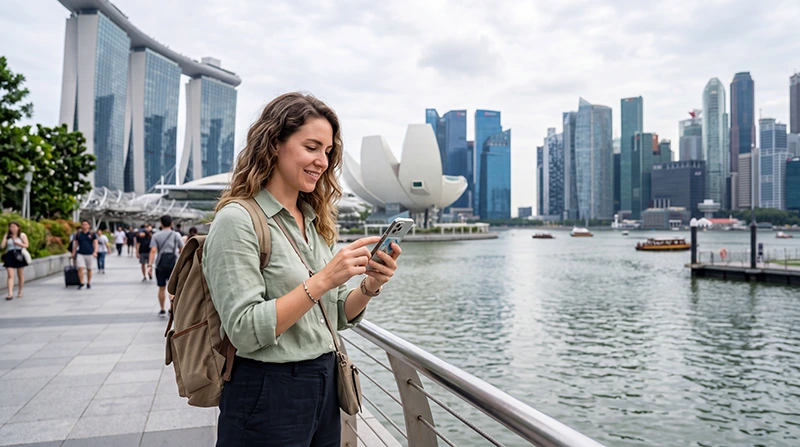

How much data for Singapore you should buy depends less on the length of the trip than on whether you stream video, join work calls or share a laptop connection. Maps, Grab and ordinary messaging use comparatively little data.
A realistic estimate starts with your phone’s recent mobile-data statistics. Exclude home Wi-Fi use, then add a margin for attraction bookings, translation, navigation and itinerary changes.
NoveSIM travel plans are data-only. WhatsApp, FaceTime and other internet apps work over data, but the eSIM does not provide a Singapore phone number or conventional calls and SMS.
Quick answer: Plan about 2–3 GB for a light three-day visit, 5–7 GB for a typical week and 10–15 GB for two weeks of maps, Grab, messaging and moderate media. Frequent video calls, streaming or hotspot use can require much more, so check recent per-app usage and disable mobile cloud backup.
Top Singapore eSIMs

Singapore eSIM
Fixed
1 GB, 7 days€ 3.052 GB, 15 days€ 4.363 GB, 30 days€ 5.23Unlimited
Unlimited, 1 day€ 3.48Unlimited, 3 days€ 6.10Unlimited, 5 days€ 8.71
How much data for Singapore should you budget?
A practical allowance by travel style
| Travel pattern | Practical starting range | Main driver |
|---|---|---|
| Stopover or weekend | 1–3GB | Maps, messages, tickets and occasional Grab rides |
| Three to five days | 3–5GB | Daily navigation, searches and moderate photo sharing |
| One week | 5–10GB | Regular social media plus travel apps |
| Heavy social or video use | 15–30GB+ | Reels, streaming, cloud photo backup and video calls |
| Remote work | 20GB+ or an unlimited option | Meetings, laptop hotspot and cloud transfers |
These are planning ranges, not guarantees. App quality settings, automatic backups and operating-system updates can move actual use far above an average. Compare the range with the validity and fair-use terms shown for the available Singapore eSIM plans.
What uses data during a normal Singapore day?
A sightseeing day may involve MRT route checks, walking navigation around Marina Bay, attraction tickets, restaurant searches and several Grab bookings. Those tasks usually remain modest because they exchange small location and text updates. The larger surprises are embedded video, high-resolution uploads and background synchronisation.
- Low use: text messages, email without large attachments, ride booking and cached map navigation.
- Moderate use: photo-heavy browsing, music, voice calls and repeated social feeds.
- High use: HD streaming, video calls, live video, cloud backups and laptop tethering.
If WhatsApp is central to the trip, see how calls, number verification and roaming interact in the dedicated guide to using WhatsApp in Singapore.
Why a daily average can be misleading
Two travellers on the same seven-day itinerary can have completely different totals. One may download maps and entertainment over hotel Wi-Fi and use less than 5GB. Another may upload videos from Sentosa, tether a laptop and consume that amount in a day.
Check Settings > Cellular/Mobile Data on iPhone or the mobile-data usage screen on Android. Look at the apps responsible for most traffic, reset the statistics if necessary, and observe a normal day away from Wi-Fi. Multiply that figure by the number of travel days and add 20–30% for unfamiliar travel tasks.
How to stop background use consuming the allowance
- Download offline areas in your map app before leaving reliable Wi-Fi.
- Pause cloud photo and video backup on mobile data.
- Disable automatic app and operating-system updates.
- Set streaming apps to data-saver or standard quality.
- Allow mobile data only for the apps you expect to use.
- Check the eSIM counter daily instead of waiting for a low-data warning.
For a broader comparison of connectivity choices, use the Singapore mobile-data guide. If you specifically want a plan marketed as unlimited, review speed-management and hotspot conditions in the unlimited Singapore eSIM guide.
Fixed data or unlimited data?
A fixed allowance is easier to budget when maps, messages and bookings are the main tasks. An unlimited option can be more comfortable for video-heavy travel or work, but “unlimited” does not always mean unrestricted full-speed use. Read the plan description for fair-use limits, speed reductions and hotspot rules before purchase.
Do not buy a much larger plan solely because public Wi-Fi might fail. Singapore has extensive hotel, venue and airport Wi-Fi, but a personal connection is useful when moving between them. The plan should cover the tasks that must work away from Wi-Fi, not every possible online activity.
Related Articles
- Best Mobile Data Options for Singapore
- Unlimited Data eSIM for Singapore
- Does WhatsApp Work in Singapore?
- Best eSIM for Singapore Travel
FAQ
Is 5GB enough for one week in Singapore?
It can be enough for maps, Grab, messaging, email and restrained social use. It is unlikely to suit frequent video streaming, automatic photo backup or laptop hotspot use.
How much data does a Singapore stopover need?
About 1GB is often sufficient for airport messaging, boarding information, maps and a short city visit. Choose more if you plan to stream or upload video.
Does Grab use a lot of mobile data?
No. Booking and tracking rides usually use much less data than video apps. Continuous social video or cloud uploads are more likely to determine the size of your plan.
Can I add more data during the trip?
That depends on the purchased plan. Check whether it supports a top-up; otherwise, a second compatible plan may be needed. Do not assume unused data or validity will carry over.
Final Recommendation
Choose 3–5GB for a short, light-use trip and 5–10GB for a typical week, then increase the allowance for streaming, hotspot work or frequent video uploads.
Install before departure, monitor the eSIM’s counter from the first day and keep backups and updates on Wi-Fi.
The best estimate is your own recent mobile usage with a travel margin—not a generic number based only on the length of the Singapore itinerary.
When deciding how much data for Singapore to buy, keep the installed eSIM profile and use data.esim only if an APN check is required.