


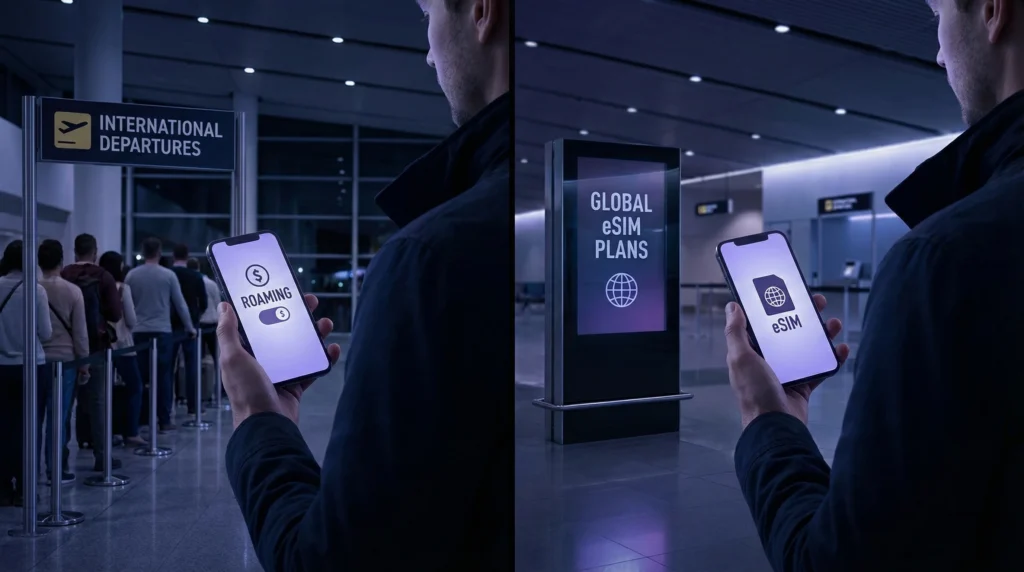
If you’re traveling abroad, you usually have two options for mobile data:
- Use roaming with your home SIM
- Use a travel eSIM
So which one is better?
👉 In most cases, a travel eSIM is cheaper, more flexible, and more reliable than roaming.
In this guide, you’ll learn:
- Key differences between eSIM and roaming
- Which one is cheaper
- Which is faster
- Which is safer
- Which is better for travelers
What is roaming?
Roaming is when your home mobile carrier connects your phone to foreign networks abroad.
When roaming is active:
- Your phone uses partner networks
- Your home carrier controls billing
- Charges are usually higher
Roaming works automatically — but often at a high cost.
What is a travel eSIM?
A travel eSIM is a prepaid mobile data plan designed specifically for international use.
Instead of using your home carrier:
- You connect directly to local networks
- You pay local data rates
- You avoid roaming fees
You install it digitally — no physical SIM required.
Cost comparison: eSIM vs roaming
In most countries:
| Option | Typical Cost |
| Roaming | expensive per MB |
| eSIM | fixed prepaid price |
Roaming charges are often calculated per MB or per day, while eSIM plans usually offer fixed data packages.
Result → eSIM is usually cheaper.
Speed comparison
Roaming connections may be slower because:
- Networks may prioritize local users
- Partner networks may limit speed
Travel eSIMs typically connect directly to local networks, which often results in better performance.
Coverage comparison
Roaming coverage depends on your carrier’s agreements. eSIM coverage depends on provider partnerships.
The difference:
- Roaming = limited by your home carrier
- eSIM = optimized for travel regions
Control and transparency
With roaming:
- Charges accumulate in background
- Bills arrive later
- Pricing can be unclear
With eSIM:
- Prepaid data
- Clear limits
- No surprises
Usage alerts guide: 👉 https://novesim.com/what-happens-when-your-esim-data-runs-out/
Setup and convenience
Roaming requires no setup but lacks control.
eSIM requires installation once, but gives:
- Full control
- Predictable pricing
- Instant activation abroad
Installation guide: 👉 https://novesim.com/how-to-activate-esim-manually/
Security comparison
Public Wi-Fi is risky. Roaming and eSIM both use mobile networks, which are more secure.
However:
- eSIM lets you disable your main SIM
- Prevents accidental roaming charges
Security guide: 👉 https://novesim.com/is-esim-safe-to-use-when-traveling/
When roaming might be better
Roaming can make sense if:
- Your carrier offers free roaming
- You travel rarely
- You only need a few MB
- You don’t want to install anything
When eSIM is better
eSIM is usually better if you:
- Travel frequently
- Need stable internet
- Want predictable pricing
- Use maps and apps
- Want local-speed data
Final verdict
For most travelers: eSIM is better than roaming.
It offers:
- Lower cost
- Better control
- Flexible plans
- Local speeds
- No surprise bills
Roaming is convenient — but eSIM is smarter.
Compare travel plans here: 👉 https://novesim.com/destinations/
Frequently asked questions
Is eSIM cheaper than roaming?
In most cases yes. eSIM plans usually cost less than standard roaming charges.
Does eSIM work better than roaming?
Often yes, because eSIM connects directly to local partner networks.
Can I use both roaming and eSIM?
Yes. You can keep roaming off on your main SIM and use eSIM for data.
Is roaming ever better?
Only if your carrier offers free or very cheap roaming.