


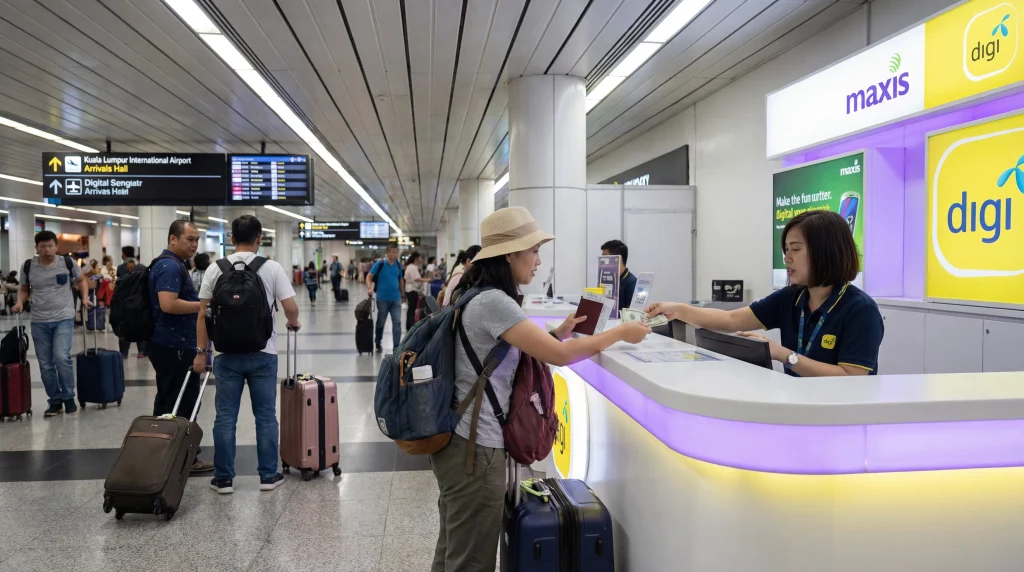

The best SIM choice for Malaysia depends on the regions in the itinerary as well as the need for a local number. A plan suitable for Kuala Lumpur and Penang should not be assumed to perform identically on every road or rural part of Sabah and Sarawak.
A travel eSIM offers advance setup on a compatible unlocked phone. A local SIM can provide domestic mobile service, but the purchase may require registration and a visit to an authorised retailer.
NoveSIM Malaysia travel eSIMs are data-only. They support apps and internet calling but do not include a Malaysian number, ordinary calls or carrier SMS.
Quick answer: Use a travel eSIM when you mainly need data and want to prepare before landing. Choose a local SIM when a Malaysian number or a specific domestic plan is necessary, and check coverage separately for Peninsular Malaysia, Sabah and Sarawak.
Top Malaysia eSIMs

Malaysia eSIM
Fixed
1 GB, 7 days€ 3.992 GB, 15 days€ 7.103 GB, 30 days€ 9.32Unlimited
Unlimited, 1 day€ 5.32Unlimited, 3 days€ 12.87Unlimited, 5 days€ 20.85
Which option is easier before arrival?
An eSIM can be installed over dependable Wi-Fi before travel, leaving the physical slot free. Follow the activation timing rather than switching it on early by assumption.
The Malaysia eSIM installation guide explains the preparation. Compatibility still depends on the exact handset variant and lock status.
Why might a traveller choose a Malaysian SIM?
A local physical SIM is worth considering when conventional domestic calls, carrier SMS or a Malaysian number are essential. Confirm registration documents, total cost and top-up access before buying.
If the home SIM must be removed, store it safely. Test mobile data, calls and the registered account before leaving the retailer.
Is buying at the airport a good idea?
Airport counters make immediate setup possible, but available bundles, opening hours and prices can change. Ask what happens after any high-speed allowance is used and whether hotspot is permitted.
A pre-arranged eSIM avoids queue and stock uncertainty. A local SIM remains an option later if the trip reveals a real need for a Malaysian number.
How do Sabah and Sarawak change the comparison?
Malaysia is not one uniform coverage environment. Cities and busy corridors on the peninsula differ from interior roads, islands and remote areas of Borneo. Match the partner network to the actual state, town and route.
Review the Malaysia network guide and keep navigation and accommodation details offline. Coverage maps describe broad availability, not a guarantee for a lodge or trail.
How much data is practical?
Maps, bookings and messages are relatively modest. Streaming, photo backup, video calls and shared laptop use require much more. Pause background uploads and monitor the travel line.
The Malaysia data guide helps estimate an allowance. Read fair-use and reduced-speed terms whenever a plan is described as unlimited.
Compare the complete offer
- Registration process and support channel.
- Validity and high-speed allowance.
- Coverage on the peninsula and the required Borneo locations.
- Hotspot or tethering terms.
- Local-number and conventional-call requirements.
Related Articles
- Best eSIM for Malaysia Travel
- Local SIM vs eSIM in Malaysia
- Mobile Internet in Malaysia
- Mobile Internet in Malaysian Borneo
FAQ
Is an eSIM or local SIM better for Malaysia?
An eSIM suits advance data setup. A local SIM is more useful when a Malaysian number or a particular domestic service is needed.
Does one Malaysian network have the same coverage everywhere?
No. Reception differs across the peninsula, Sabah, Sarawak, islands and rural routes.
Does a NoveSIM Malaysia eSIM include calls?
No. It is data-only; internet calling apps work through data, but conventional calls and carrier SMS are not included.
Should I buy an airport SIM?
It can be convenient, but compare the full allowance, validity, registration, hotspot terms and route coverage before paying.
Final Recommendation
Choose a travel eSIM when fast pre-arrival data setup matters, and a local SIM when its Malaysian number or domestic features are necessary.
Evaluate Peninsular Malaysia, Sabah and Sarawak separately instead of assuming one city test represents the entire trip.
Confirm registration, fair-use limits and hotspot rules, then keep essential travel information available offline.