



The best SIM card for a Canada trip depends first on whether you need a Canadian phone number. If you need ordinary calls or SMS to that number, compare a Canadian mobile plan. If you mainly need maps, bookings and messaging apps, a data-only travel eSIM may be simpler to prepare before departure.
Canada has several ways to obtain a local plan, but a familiar national carrier name is not necessarily the route to a new prepaid account. Bell directs new prepaid customers to Lucky Mobile, and Rogers directs them to chatr. Public Mobile and Freedom Mobile also offer prepaid or subscription routes. Availability, activation requirements and plan terms must be checked with the operator before you travel.
NoveSIM is the travel-data option in this comparison. Our Canada eSIM does not provide a Canadian number, conventional calls or SMS. It can carry internet messaging and calls on a compatible unlocked phone where mobile data is available; keeping your home line active for its number may still expose you to home-carrier call or text charges.
Quick answer: For a short visit without a local-number requirement, compare a Canada travel eSIM with your existing roaming plan. For a Canadian number and cellular calls or texts, compare current local plans from Lucky Mobile, chatr, Public Mobile or Freedom Mobile, then confirm whether the chosen service can be activated with a physical SIM or operator eSIM on your exact phone. Do not buy solely because a kiosk, brand or headline price looks familiar.
Top Canada eSIMs


Start with the Service You Actually Need
| Choice | Most useful when | Check before paying |
|---|---|---|
| Canadian prepaid physical SIM | Your phone has a SIM slot and you want a local mobile plan | Number, calls, SMS, data, activation, coverage and renewal terms |
| Canadian operator eSIM | You want a local plan without inserting a card | Exact device eligibility, local-number inclusion and activation route |
| NoveSIM Canada travel eSIM | You need data for a trip and can install before arrival | Phone compatibility, validity, allowance, partner access and hotspot terms |
| Existing home-carrier roaming | Your own plan already includes suitable Canada use | Data allowance and triggers for calls, texts or daily charges |
A physical SIM and an operator eSIM can carry the same type of Canadian mobile service; the format alone does not tell you whether a number or voice service is included. Conversely, a travel eSIM is not a substitute for a local number merely because it uses eSIM technology. See the Canada travel eSIM selection guide if your decision is about a data plan rather than domestic telephone service.
Which Local Prepaid Routes Are Worth Checking?
Lucky Mobile: Bell’s current prepaid guidance points new activations to Lucky Mobile. Lucky’s official prepaid page shows both a physical-SIM route and an eSIM activation route, with plans that describe Canada-wide calls and texts. Lucky also advertises a separate tourist eSIM: check that specific offer’s services rather than assuming it has the same number and calling features as a regular prepaid plan. Do not assume a Bell-branded prepaid offer is still open to a new visitor.
chatr: Rogers says new prepaid service is handled through chatr rather than Rogers Prepaid. Its prepaid notice points shoppers to chatr plans and store information. Check the chatr plan itself for the number, data and any activation or payment conditions before relying on it for a short stay.
Public Mobile: Public Mobile says its app supports activation with a physical SIM or eSIM. That may suit a traveller willing to complete the app-led signup, but verify the current subscription, phone compatibility and payment requirements before arrival.
Freedom Mobile: Freedom says visitors from outside Canada can join and that prepaid plans do not require a credit check. Its activation guidance covers standalone physical SIMs and online eSIM activation for bring-your-own-phone customers. Check the plan’s coverage for the places you will visit, especially if the trip goes beyond a major city.
These are routes to investigate, not a promise that every plan is available at every airport or suitable for every foreign handset. Their terms can change; the operator’s current checkout and compatibility checks decide what you can activate.
When Is a Local Number Worth the Extra Setup?
A Canadian number can matter if an employer, landlord or service needs to reach you by ordinary mobile call or SMS. Some visitors also prefer a domestic plan for a long stay. Confirm that the exact plan includes the calls and texts you need, and ask how the number is assigned and renewed.
For a short holiday, a local number may add little if your contacts use WhatsApp or other internet apps and your bookings can be managed online. A NoveSIM Canada data plan can be installed before departure on a compatible unlocked phone, avoiding an immediate search for a shop. It will not receive conventional SMS sent to a new Canadian number.
Physical SIM or Operator eSIM?
Choose a physical card if your phone has an available SIM slot and you want an in-person purchase or your phone does not support eSIM. Confirm that the handset is unlocked and compatible with the operator’s network. If your main SIM occupies the only slot, changing cards may take your home number offline unless your phone supports another active line.
An operator eSIM avoids swapping plastic but still requires that the exact phone model and the operator’s activation process support it. A local operator eSIM can be a domestic phone plan with a number; it is not automatically a tourist data eSIM. Check the service features rather than treating “eSIM” as a plan category.
Compare the Whole Stay, Not a SIM Price
Check the plan’s billing period, total data, any speed reduction, hotspot rules, tax or activation charges and how to stop or renew service. A monthly prepaid plan may be sensible for a long stay but less convenient for a brief arrival. A small travel-data plan may fit a weekend while being insufficient for regular video calls or laptop tethering. Use the Canada data-use guide to estimate the allowance before comparing totals.
Coverage also matters. A plan that works at your first hotel does not prove service along a remote highway, park road or mountain route. Check the current coverage information for the specific operator or travel-eSIM plan, and keep key directions and addresses offline. Do not equate a larger data allowance with wider coverage.
Do Not Make Airport Stock Your Only Plan
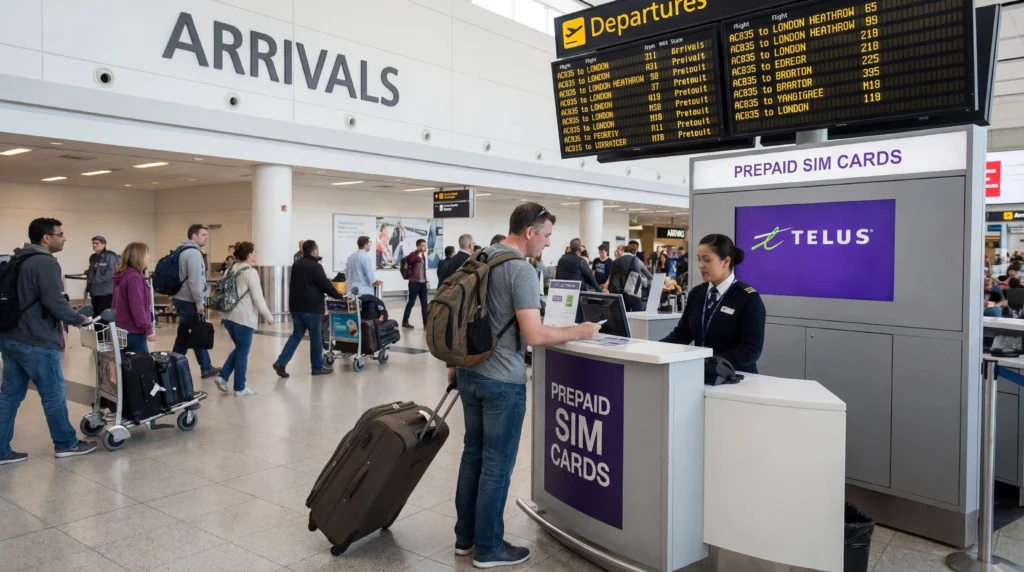
If you intend to buy a Canadian SIM after landing, confirm the retailer’s location, opening hours, accepted payment and plan availability close to departure. A store in the city may offer a different choice from an airport counter. Keep your first transfer, accommodation address and booking details available offline in case you leave the terminal before activating a local plan.
A travel eSIM can be useful as arrival data even if you later choose a Canadian number. That is a separate purchase decision: compare the cost of two services with the benefit of being connected during the first hours, rather than assuming you need both.
Related Articles
- Choose a Canada travel eSIM plan
- Estimate data for your Canada stay
- Check home-carrier roaming charges in Canada
FAQ
What is the best SIM card for a tourist in Canada?
If you need a Canadian number with ordinary calls or SMS, compare current local plans and their activation requirements. If you only need mobile data for a short visit, a compatible travel eSIM may be easier to arrange before departure. No single option fits both needs automatically.
Can I still get a new prepaid plan directly from Bell or Rogers?
Bell currently directs new prepaid activations to Lucky Mobile, while Rogers directs new prepaid customers to chatr. Check each company’s current guidance before travel because the sales route can change.
Will a Canadian operator eSIM give me a local number?
It can if the selected operator plan includes one. The digital SIM format does not determine the services; verify the number, calls and texts in the exact plan details.
Does a NoveSIM Canada eSIM include calls or SMS?
No. NoveSIM travel eSIMs are data-only. Internet calling and messaging apps can use the data connection, while conventional calls and SMS require another suitable mobile line.
Final Recommendation
For a short Canada trip centred on maps, bookings and internet messaging, compare a travel eSIM with the roaming already included in your home plan. For a Canadian number or conventional cellular calls and SMS, compare current local prepaid routes and choose the physical SIM or operator eSIM format your unlocked phone can activate.
Before paying, verify the exact plan’s service features, coverage, validity and complete cost. If you plan to buy locally after arrival, confirm where and when you can activate it and keep your first journey available offline.
The right SIM choice is the one that provides the services you will actually use in Canada, not simply the cheapest card or the plan with the largest advertised data figure.