


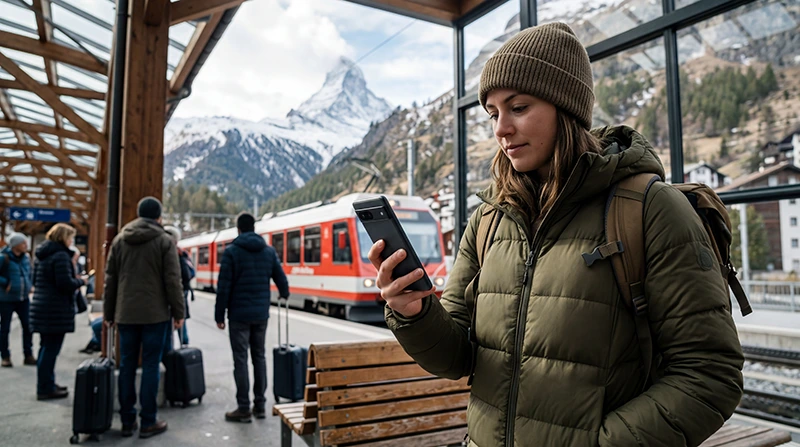

The best Swiss mobile network for a visitor is the one that covers the actual route and is available through the chosen SIM or eSIM plan. Switzerland has three national operators—Swisscom, Sunrise and Salt—but a travel eSIM may provide access to only one or a subset of them.
Coverage in Zurich or Geneva does not answer what will happen on a rail journey, in an alpine valley or inside a mountain building. Operator maps are predictions, so compare the places where dependable data matters most and keep essential directions offline.
NoveSIM travel eSIMs are data-only. They provide internet for maps, SBB Mobile and app-based calls, but no Swiss number or conventional calls and SMS.
Quick answer: Do not choose only by a national coverage percentage. Check which Swiss partner network the exact plan uses, compare its official map along your cities and rail or road route, and confirm hotspot and 5G terms before buying.
Top Switzerland eSIMs

Switzerland eSIM
Fixed
1 GB, 7 days2.50$2 GB, 15 days3.50$3 GB, 30 days5.00$Unlimited
Unlimited, 1 day3.00$Unlimited, 3 days6.50$Unlimited, 5 days10.50$
Europe Extra eSIM
Fixed
1 GB, 7 days2.50$2 GB, 15 days4.00$3 GB, 30 days5.00$Unlimited
Unlimited, 1 day3.00$Unlimited, 3 days6.00$Unlimited, 5 days10.00$Europe+ eSIM
Fixed
1 GB, 7 days3.00$2 GB, 15 days4.50$3 GB, 30 days6.00$Unlimited
Unlimited, 1 day3.00$Unlimited, 3 days7.00$Unlimited, 5 days11.50$Europe Lite eSIM
Fixed
1 GB, 7 days2.50$2 GB, 15 days4.00$3 GB, 30 days5.00$Unlimited
Unlimited, 1 day3.00$Unlimited, 3 days6.00$Unlimited, 5 days10.00$Which Swiss Mobile Network Should a Tourist Choose?
Swisscom, Sunrise and Salt all operate their own Swiss networks. The practical distinction is not simply which logo is “best”, but whether the plan gives access to the network that performs well where you will travel.
- Swisscom: worth checking for itineraries that prioritise broad national and alpine coverage. Swisscom states that its 5G network reaches 99% of the population, but population coverage is not the same as uninterrupted service on every trail or in every tunnel.
- Sunrise: a national alternative whose live coverage map should be checked for the exact towns, transport corridors and accommodation locations on the itinerary.
- Salt: another national network that can suit many urban and tourist routes; verify the precise route rather than assuming that one city result represents the whole trip.
Switzerland’s Federal Office of Communications also publishes a broadband atlas with expected 3G, 4G and 5G availability. It notes that participation is voluntary and operators remain responsible for their submitted coverage data, so maps are planning tools rather than guarantees.
Coverage for Cities, Trains and the Alps
Central areas of major cities normally give a phone more sites and capacity to choose from. On trains, the signal can change quickly as the route enters cuttings, tunnels and less populated valleys. A route with several handovers may feel less stable than a stationary city connection even when both are shown as covered.
For rail-heavy itineraries, read internet for Swiss train travel. Hikers and skiers should use the Swiss Alps connectivity guide and download maps before leaving a town. Mobile coverage is useful but must not be treated as an emergency-safety guarantee.
On a road trip, check the planned roads and mountain passes on the coverage map rather than judging the plan by Zurich or Geneva alone. Download the driving route, charging stops if using an EV, and accommodation details before entering a tunnel or remote valley. Live traffic and parking apps need data, but offline directions let you continue when the signal drops; do not assume that a 5G icon on one stretch predicts reception on the next.
Does 5G Matter for a Switzerland Trip?
For tickets, navigation and messaging, reliable 4G is usually more valuable than briefly seeing a 5G icon. Swisscom and Sunrise ended their 3G networks by the end of 2025, according to OFCOM, so an older 3G-only device is not suitable for dependable use in Switzerland.
5G access depends on the phone, plan, partner network, location and network load. A plan may connect to a network without including that network’s fastest technology. Check device compatibility and the live plan details rather than assuming every eSIM receives 5G.
How to Compare a Travel eSIM’s Network Access
- List the cities, mountain bases and long transport legs on the itinerary.
- Check the eSIM plan page for the named Swiss partner network or networks.
- Open those operators’ current coverage maps and inspect the route at street or valley level.
- Confirm whether 5G and hotspot use are included, if either matters.
- Review the plan’s data allowance, validity and fair-use terms.
- Save tickets, accommodation details and offline maps before remote travel.
If the main decision is between connectivity products rather than networks, use our Switzerland internet options comparison. For data sizing, see how much data a Switzerland trip needs.
What to Do When the Phone Chooses a Weak Network
Start with automatic network selection. If the plan allows more than one partner and the connection repeatedly fails, note the location and test another supported network manually. Return to automatic selection before continuing a long route so the phone can hand over normally.
When the eSIM registers but data does not load, confirm the selected data line, enable roaming on the travel eSIM and verify the NoveSIM APN is data.esim. Keep the installed eSIM while following the Switzerland troubleshooting sequence; delete it only if support instructs you to.
Related Articles
- Best Internet Option for Switzerland
- Internet in the Swiss Alps
- Internet for Swiss Train Travel
- Switzerland eSIM Troubleshooting
FAQ
What is the best mobile network in Switzerland for tourists?
There is no universal answer. Compare the network offered by the exact plan with official coverage maps for your cities, rail lines and mountain stops.
Are Swisscom, Sunrise and Salt the main Swiss networks?
Yes. They operate Switzerland’s national mobile networks, while travel eSIMs may connect through one or more of them depending on the plan.
Will a Switzerland eSIM always include 5G?
No. 5G depends on the plan, partner network, compatible device, location and local capacity. Check the current plan description.
Is mobile coverage reliable on every Swiss train and hiking route?
No. Service can weaken in tunnels, deep valleys and remote terrain. Save maps, tickets and essential information offline.
Final Recommendation
Choose a Swiss mobile network by matching the plan’s partner access to the route, not by relying on one national headline.
Use official coverage maps for cities, rail corridors and alpine stops, while allowing for buildings, tunnels and terrain.
Keep automatic selection enabled for normal travel, prepare offline essentials and confirm 4G, 5G and hotspot terms on the exact plan.