


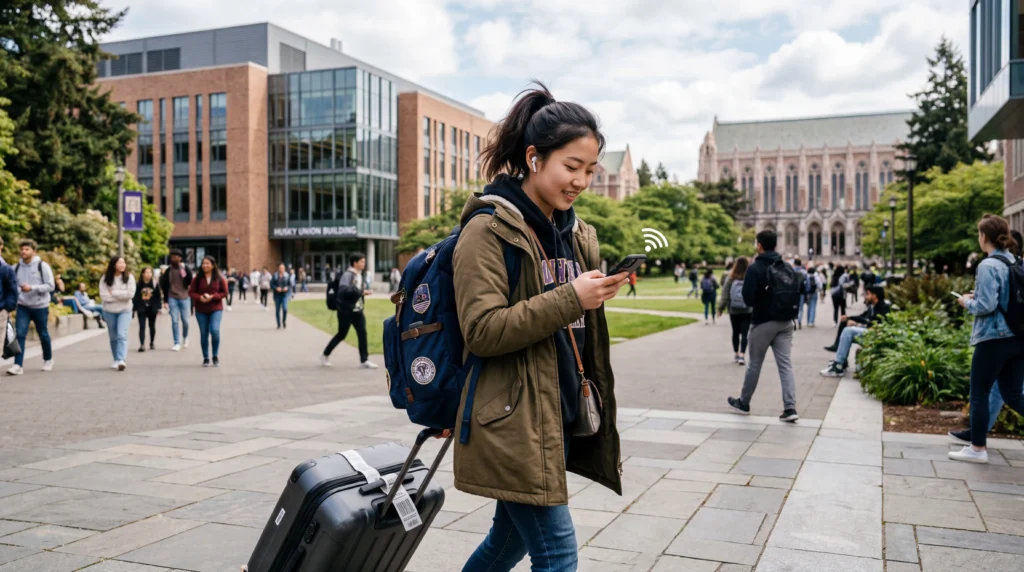

The best eSIM for an international student in the USA depends on whether the immediate need is arrival data or a complete long-term phone service. A travel eSIM can provide internet from the first day, but students who need a US number for calls, SMS or institutional accounts may later require a local mobile plan.
That distinction matters. Maps, messaging, email and internet calls work over data, while some banks, landlords, employers and campus services may request a domestic number or carrier SMS.
NoveSIM travel eSIMs are data-only and do not include a US telephone number, conventional voice minutes or SMS.
Quick answer: Use a travel eSIM for immediate data during arrival and the first days in the USA. Before choosing it for a semester, confirm the allowance, validity and hotspot terms, then decide separately whether a US number is necessary.
Top eSIMs

Review current USA travel eSIM options, confirm the phone on the compatible-device list and read how NoveSIM works.
Arrival Data and Long-Term Service Are Different Decisions
Arrival data solves urgent tasks: opening directions, contacting accommodation, accessing campus instructions, receiving internet messages and arranging transport. It can be installed before departure, avoiding a rushed mobile-plan decision immediately after a long flight.
A semester plan must also account for recurring data, hotspot use, domestic calling and account verification. Students should not assume that a data-only eSIM replaces every function of a US carrier plan.
When a US Number May Be Needed
Internet apps can handle most personal communication, but carrier calls and SMS may still matter for administrative tasks. Ask the university, bank, landlord and employer what they accept. If a US number is required, compare local service after arrival while keeping the travel eSIM for the transition.
Estimate Student Data Use
Navigation, email and messages are relatively light. Video lectures, conferencing, streaming, laptop tethering and cloud synchronisation can use many times more data. Campus and accommodation Wi-Fi may reduce mobile use, but it should not be assumed before it has been tested.
For the first week, keep a reserve for orientation changes, housing issues and transport. Pause operating-system updates and full photo backup on mobile data.
Dual-SIM Setup for Arrival
Install the travel eSIM on dependable Wi-Fi and follow the plan’s activation instructions. On arrival, select it for mobile data and enable Data Roaming on that line. Turn off mobile-data switching to prevent the home SIM from silently using expensive roaming.
The home SIM can remain enabled if needed for incoming verification messages, provided its data roaming is disabled and the home carrier’s charges are understood.
FAQ
Can a travel eSIM replace a US student phone plan?
It can cover mobile-data needs, but it does not replace a domestic number, conventional calls or carrier SMS. The answer depends on what the university and other services require.
Can I use WhatsApp and video calls?
Yes, internet-based communication can use eSIM data. Quality depends on local coverage, congestion, the device and the selected plan.
Can I keep my home SIM active?
Yes on a compatible dual-SIM phone. Select the travel eSIM for data, disable data switching and check the home carrier’s charges for calls and SMS.
Should I buy a full-semester allowance before arrival?
Only after checking validity, hotspot rules and likely Wi-Fi access. An arrival plan gives time to understand real needs before committing to longer-term service.
Final Recommendation
For most international students, a travel eSIM is strongest as an immediate arrival connection. It provides time to reach accommodation, complete orientation and compare local services without being offline.
Choose a longer data plan only when its validity and allowance fit the semester routine. If a US number is required, treat that as a separate service decision rather than expecting a data-only eSIM to provide it.