


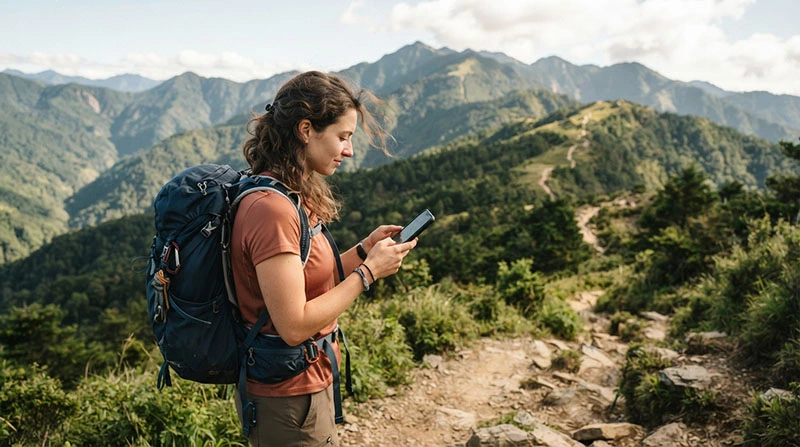

Backpacking Taiwan requires a connection that works across transport days, hostel changes and day trips—not only in Taipei. Mobile data supports route planning, translation, accommodation messages and weather checks, while offline maps protect the journey when mountains or tunnels interrupt reception.
An eSIM is convenient for travellers who want data ready after landing. A local SIM may be preferable when a Taiwanese number is important, and hostel WiFi is useful for large downloads but cannot cover the route between stays.
NoveSIM travel eSIMs are data-only. They do not include a local phone number or conventional calls and SMS, but messaging and internet calls work through mobile data.
Quick answer: Choose enough data for daily maps, transport and accommodation research, install the eSIM before departure, and download each remote route offline. Keep mobile data for live changes and use hostel WiFi for backups, updates and entertainment.
Top Taiwan eSIMs

Taiwan eSIM
Fixed
1 GB, 7 days€ 4.842 GB, 15 days€ 7.933 GB, 30 days€ 11.01Unlimited
Unlimited, 1 day€ 4.40Unlimited, 3 days€ 11.45Unlimited, 5 days€ 18.49
What backpackers use mobile data for
- Rail, bus and metro planning between cities.
- Walking navigation from a station to a hostel.
- Translation and address details in Chinese.
- Weather and trail-condition checks.
- Messages from accommodation and tour operators.
- Last-minute bookings when the route changes.
These tasks are individually light, but constant research can add up over a long trip. Video, automatic photo backup and hotspot use usually consume more data than the core backpacking tools.
Pick a plan for the whole route
| Backpacking style | Main data use | Plan consideration |
|---|---|---|
| Short city route | Maps, messaging and bookings | Smaller fixed allowance may be enough |
| Independent multi-city trip | Daily transport research and social sharing | More headroom and full-trip validity |
| Long stay or laptop use | Calls, uploads and hotspot | Larger allowance and clear tethering rules |
Use the Taiwan data calculator guide for a more detailed estimate. Check whether an unlimited-style offer limits full-speed data each day.
Coverage along a typical backpacking route
Taipei and the main western cities are generally the easiest places to stay connected. Signal can be more variable on the east coast, in mountain areas and around remote trail access points. A network with broad national coverage still cannot guarantee service behind every ridge or inside every tunnel.
- Taipei and northern day trips: prepare offline directions for mountain villages and trails.
- Taichung and Sun Moon Lake: save the onward bus route before leaving the city.
- Chiayi and Alishan: keep accommodation and transport details offline.
- Hualien and the east coast: expect more variation between populated areas.
- Tainan, Kaohsiung and Kenting: city access is easier than isolated coastal sections.
Read the Taiwan network guide before choosing a plan for a route that spends significant time outside cities.
Prepare for weak-signal days
- Download the next map area while still on reliable WiFi.
- Save hostel addresses, door codes and check-in messages locally.
- Screenshot the relevant ticket or reservation when permitted.
- Download translation details for food, transport and emergencies.
- Tell someone the planned route before a remote hike.
Mobile data is a useful travel tool, but it is not an emergency guarantee in isolated terrain.
Save data without losing useful access
Disable automatic cloud backups, application updates and video autoplay on the eSIM line. Download music and programmes at the hostel. Keep background data for the apps that deliver transport or accommodation changes, and review per-app usage during a long trip.
eSIM or local SIM for backpacking?
An eSIM is easy to organise before travel and leaves the physical SIM slot available. A local prepaid SIM may provide a Taiwanese number, depending on the offer, but requires purchase and registration. Compare the options in Local SIM vs eSIM in Taiwan.
If your route continues to another country, verify whether the plan covers both destinations rather than assuming a Taiwan plan will roam regionally.
Using a hotspot in hostels and on transport
A permitted hotspot can connect a laptop or another traveller’s phone, but it increases battery use and can deplete a small allowance quickly. Do not leave the navigation phone without power. For substantial work, use a power bank and download documents before departure.
Install the eSIM before the first travel day
- Confirm that the phone supports eSIM and is unlocked.
- Install the plan over stable WiFi before departure.
- After landing, select the travel eSIM for mobile data.
- Enable Data Roaming on that line when required.
- Leave automatic network selection enabled.
- Test maps and messaging before leaving the arrival area.
See the Taiwan installation guide for complete steps. If data does not work, do not delete the eSIM; use data.esim if manual NoveSIM APN entry is required and follow the troubleshooting guide.
Related Articles
- Taiwan eSIM Plans
- Mobile Internet in Taiwan
- Internet for Budget Travel in Taiwan
- Internet for Taiwan Train Travel
FAQ
How much data does a Taiwan backpacker need?
It depends on trip length and habits. Maps, messages and bookings are light; video, photo backup, calls and hotspot use require much more.
Will mobile data work on mountain routes?
Coverage can weaken where terrain blocks the network. Download maps and essential trip details before entering remote areas.
Can I keep my usual SIM active?
Yes, on a compatible dual-SIM phone. Select the travel eSIM for data and prevent the home line from using paid roaming data.
Can backpackers share one eSIM?
They can share the host phone’s hotspot if tethering is allowed, but separate plans are safer when travellers split up.
Final Recommendation
Choose a backpacking connection for the complete route, not only for the first city.
Use mobile data for changing transport and accommodation details, while keeping maps and critical information offline.
A prepared eSIM, controlled data usage and a charged phone provide a more resilient setup across Taiwan’s cities, coast and mountain approaches.