


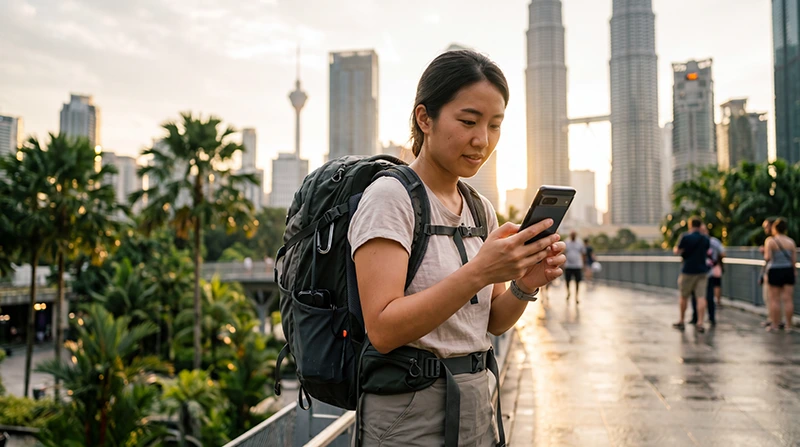

Malaysia is one of the best backpacking destinations in Southeast Asia. Affordable transportation, budget accommodation, diverse cultures, incredible food, tropical islands and modern infrastructure make it attractive for both first-time and experienced backpackers.
Whether you are exploring Kuala Lumpur, Penang, Langkawi, the Perhentian Islands, Cameron Highlands, Malacca, Sabah or Sarawak, reliable internet access can make your backpacking trip easier, safer and more flexible.
Quick answer: Most backpackers choose an eSIM because it can be installed before departure, activated after arrival and used immediately throughout Malaysia without needing to visit a mobile store.
Top Malaysia eSIMs

Malaysia eSIM
Fixed
1 GB, 7 days€ 3.932 GB, 15 days€ 6.983 GB, 30 days€ 9.16Unlimited
Unlimited, 1 day€ 5.24Unlimited, 3 days€ 12.65Unlimited, 5 days€ 20.51
Why Backpackers Need Mobile Internet in Malaysia
Backpacking usually involves frequent movement between destinations, flexible travel plans and last-minute decisions.
Mobile internet helps backpackers:
- Book hostels and hotels
- Use Google Maps navigation
- Check bus schedules
- Book ferry tickets
- Order Grab rides
- Find restaurants
- Translate local languages
- Stay in contact with family
- Meet other travelers
- Access travel information
Without internet access, many of these tasks become more difficult while traveling independently.
Internet Options for Backpackers
Backpackers visiting Malaysia generally have four internet options.
| Option | Best For | Main Advantage | Main Limitation |
|---|---|---|---|
| eSIM | Most modern smartphones | Install before travel | Requires eSIM support |
| Local SIM Card | Phones without eSIM support | Widely available | Requires physical installation |
| Roaming | Short trips | No setup required | Often expensive |
| Public WiFi | Backup internet | Usually free | Limited coverage |
Why Many Backpackers Choose eSIMs
Backpackers often arrive in Malaysia with tight schedules and limited budgets.
Instead of searching for a SIM card vendor at the airport, an eSIM allows travelers to install everything before departure and activate mobile internet immediately after arrival.
This is especially useful when arriving late at night or traveling directly to another destination.
Benefits of Using an eSIM While Backpacking
- Install before departure
- No airport SIM card queues
- No physical SIM replacement
- Keep your regular SIM active
- Immediate internet after arrival
- Works throughout Malaysia
- Useful for multi-country trips
- Ideal for flexible travel plans
Popular Backpacking Routes in Malaysia
Most backpackers follow a route that combines cities, nature and islands.
- Kuala Lumpur
- Malacca
- Penang
- Langkawi
- Cameron Highlands
- Perhentian Islands
- Tioman Island
- Kota Kinabalu
- Kuching
- Borneo Rainforests
Reliable internet is useful throughout these destinations for transportation and accommodation planning.
Internet for Backpacking Kuala Lumpur
Kuala Lumpur is usually the first stop for many backpackers.
Internet access helps with:
- KLIA Airport transfers
- Public transportation
- Hostel bookings
- Food recommendations
- Budget travel planning
Most travelers use mobile internet heavily during their first days in the city.
Internet for Backpacking Penang
Penang is one of Malaysia’s favorite destinations among backpackers.
Mobile internet helps travelers navigate:
- George Town
- Street food areas
- Hostels
- Beach destinations
- Public transport
Many travelers spend entire days walking through George Town using maps and travel apps.
Internet for Backpacking Langkawi
Langkawi offers affordable island experiences and beautiful beaches.
Travelers often use internet access for:
- Island hopping tours
- Accommodation bookings
- Transportation arrangements
- Navigation
- Tour reservations
Coverage is generally strong across the island’s main tourist areas.
Internet for Backpacking Borneo
Sabah and Sarawak attract adventure travelers looking for wildlife and nature experiences.
Internet access is useful for:
- National park reservations
- Wildlife tours
- Transportation planning
- Accommodation bookings
- Emergency communication
Coverage is strongest in cities and tourist zones.
How Much Data Does a Backpacker Need?
Most backpackers use between 5GB and 15GB during a two-week trip.
| Usage Type | Recommended Data |
|---|---|
| Light Usage | 3–5 GB |
| Average Backpacker | 5–10 GB |
| Heavy Usage | 10–20 GB |
| Content Creator | Unlimited |
Travelers who frequently upload videos or use social media heavily may prefer unlimited data plans.
Can You Rely on Hostel WiFi?
Most hostels provide WiFi, but quality varies significantly.
Common issues include:
- Slow speeds
- Network congestion
- Weak room coverage
- Security concerns
- Downtime during busy periods
Many backpackers use hostel WiFi as a backup while relying on mobile internet as their primary connection.
Can You Keep Your Home SIM Active?
Yes.
Most modern smartphones support dual SIM functionality.
This allows backpackers to keep their regular SIM active while using an eSIM for mobile data.
This is useful for:
- SMS verification codes
- Banking messages
- Two-factor authentication
- Calls on your regular number
Does WhatsApp Work with an eSIM?
Yes.
WhatsApp generally continues working with your existing phone number while the eSIM provides internet access.
You usually do not need to change your account.
Do You Need Data Roaming Enabled?
Yes.
Most travel eSIMs require Data Roaming to be enabled on the eSIM profile.
Keep roaming disabled on your primary SIM and enabled only on the travel eSIM.
APN Settings for Malaysia eSIM
If manual configuration is required, use the following settings:
| Setting | Value |
|---|---|
| APN | data.esim |
| Username | Leave blank |
| Password | Leave blank |
What If Your Internet Does Not Work?
If your mobile internet does not connect:
- Check that the eSIM is enabled
- Select the eSIM for mobile data
- Enable Data Roaming
- Verify APN settings
- Turn airplane mode on for 30 seconds
- Restart your phone
- Wait for network registration
Most connectivity issues can be solved using these troubleshooting steps.
Related Malaysia Travel Guides
- Internet for Malaysia Vacation
- How Much Data for Malaysia
- Unlimited Data eSIM Malaysia
- Best Mobile Data Malaysia
- Best eSIM for Malaysia
- Mobile Internet Malaysia
- How to Get Internet in Malaysia
FAQ: Internet for Backpacking Malaysia
What is the best internet option for backpacking in Malaysia?
For most backpackers, an eSIM is the easiest and most convenient solution because it can be installed before travel and activated immediately after arrival.
How much data do backpackers usually need?
Most backpackers use between 5GB and 15GB during a two-week trip depending on their internet habits.
Can I rely only on hostel WiFi?
Hostel WiFi can be useful, but mobile internet is generally more reliable and flexible while traveling.
Does WhatsApp work with an eSIM?
Yes. WhatsApp usually continues working with your existing phone number.
Can I keep my home SIM active?
Yes. Most dual-SIM smartphones allow you to use an eSIM for data while keeping your primary SIM active.
Do I need Data Roaming enabled?
Yes. Most travel eSIMs require Data Roaming to be enabled on the eSIM profile.
What APN should I use?
If manual setup is required, use data.esim and leave username and password fields blank.
Is an eSIM better than buying a SIM card in Malaysia?
For most backpackers, yes. An eSIM saves time and provides internet access immediately after arrival.
Final Recommendation
Backpacking in Malaysia becomes significantly easier when you have reliable internet access from the moment you arrive.
An eSIM is usually the best choice because it eliminates the need to find a SIM card vendor, allows you to keep your home SIM active and provides instant connectivity throughout your journey.
If your trip includes Kuala Lumpur, Penang, Langkawi, Borneo and other destinations across Malaysia, mobile internet will help you navigate, book accommodation, communicate and travel with confidence.