


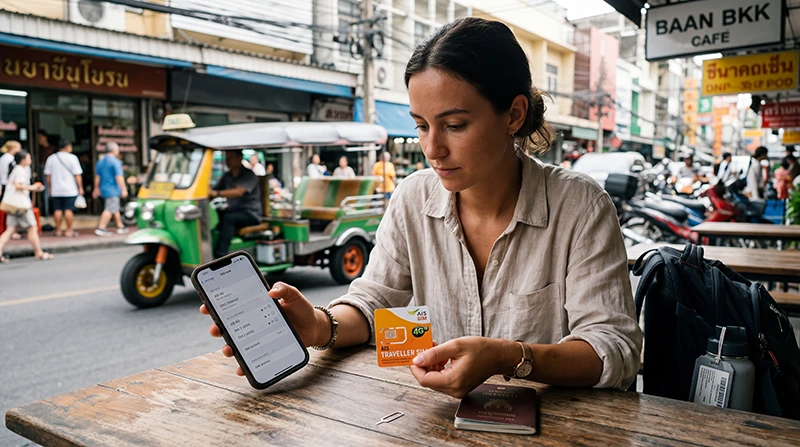

The Thailand local SIM vs eSIM decision is not about radio format alone: both can use the same underlying mobile networks, but buying and setup differ. The right choice depends mainly on whether you need a Thai number, want data before landing and have an unlocked eSIM-compatible phone.
Local prepaid SIMs are registered in Thailand and commonly sold with tourist packages. A travel eSIM is delivered digitally, so no plastic card or airport counter is required.
NoveSIM travel plans are data-only and do not provide a Thai number, conventional calls or SMS. Data-based calls and messages remain available through compatible apps.
Quick answer: Pick a local SIM for a Thai number and face-to-face operator help. Pick an eSIM for advance installation, a free physical SIM slot and a quicker arrival. Network performance depends on the plan’s partner network and your location—not whether the profile is plastic or digital.
Top Thailand eSIMs

Thailand eSIM
Fixed
1 GB, 7 days€ 3.082 GB, 15 days€ 5.283 GB, 30 days€ 7.05Unlimited
Unlimited, 1 day€ 3.96Unlimited, 3 days€ 10.13Unlimited, 5 days€ 15.41
Thailand local SIM vs eSIM: what is the practical difference?
| Question | Local Thai SIM | Travel eSIM |
|---|---|---|
| When obtained | Usually after arrival | Can be installed before travel |
| Thai number | Normally included | Not included with NoveSIM data plans |
| Registration | Passport registration required | Provider purchase process applies |
| Physical slot | Uses a SIM slot | Uses the phone’s eSIM capability |
| Support | Operator shop or counter | Online provider support |
Which option is easier on arrival?
An eSIM can be installed on trusted Wi-Fi before departure, then selected for mobile data after landing. A local SIM involves finding a counter, presenting identification and waiting for registration, but staff may complete setup for you.
If you choose digital setup, read the Thailand eSIM activation guide before flying. If you prefer a shop purchase, compare the practical buying points in the Thailand tourist SIM guide.
Is one option cheaper?
There is no permanent price winner because tourist packages, exchange rates and promotions change. Compare plans for the same number of days and the same high-speed allowance. Include transport to a shop, airport convenience, hotspot limits and any post-threshold speed reduction.
Estimate your allowance with the Thailand mobile-data guide before comparing totals.
Does a physical SIM have better coverage?
Not automatically. Coverage follows the operator network the plan can access, plus local terrain, buildings, congestion and device support. An eSIM on an appropriate partner network may perform similarly to a physical SIM on that network.
Check Bangkok, northern routes and island stops separately in the Thailand network comparison. No national coverage claim guarantees reception inside one hotel or on an offshore crossing.
Which is better for dual-SIM use?
An eSIM is useful when you want to leave the home physical SIM inserted for bank messages. Select the travel line for data, turn off roaming on the home line and disable automatic data switching. A phone with two physical slots can achieve a similar arrangement with a local SIM.
What about multi-country travel?
A Thai local SIM is centred on Thailand. A regional eSIM may be simpler when the same plan explicitly includes every country in the itinerary. For example, check the dedicated Singapore and Thailand eSIM guide rather than assuming an “Asia” label covers both.
Related Articles
FAQ
Is an eSIM better than a local SIM in Thailand?
An eSIM is usually more convenient before arrival; a local SIM is preferable when you need a Thai number. Coverage depends on the network available to the specific plan.
Can I use my home SIM and a Thailand eSIM together?
Yes, on a compatible dual-SIM phone. Use the eSIM for data and disable roaming and data switching on the home line.
Does a local Thai SIM require identification?
Local prepaid SIM registration normally requires a passport, so purchase through an official operator or authorised outlet.
Can a travel eSIM receive Thai calls?
A data-only NoveSIM eSIM has no Thai number and cannot receive conventional calls or SMS. Internet calling apps can use its data connection.
Final Recommendation
Choose a local Thailand SIM when a domestic number or shop assistance outweighs the time required to buy and register it.
Choose an eSIM when your compatible unlocked phone lets you prepare mobile data before departure and retain the home SIM.
The Thailand local SIM vs eSIM choice should follow current allowances, networks and number requirements. For a NoveSIM profile, the manual APN is data.esim; keep the installed eSIM if connection checks are needed.