


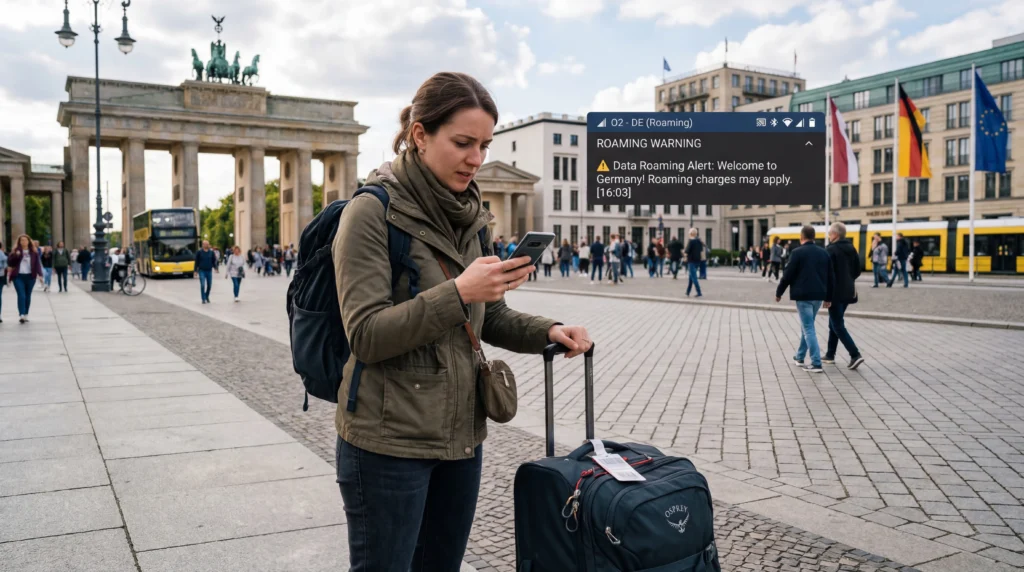

Roaming charges in Germany are determined by the SIM’s home operator and tariff. Travellers with an eligible EU or EEA plan can normally use regulated roaming terms, while UK, US and other non-EU visitors may face a daily pass, an add-on or metered charges.
Germany’s EU membership does not make mobile service free for every foreign SIM. The decisive information is whether the home carrier includes Germany, how much data is allowed and what triggers a charge.
NoveSIM travel eSIMs are prepaid and data-only. We do not provide a German telephone number or conventional calls and SMS, so the primary SIM can remain available for those services under its own carrier terms.
Quick answer: Check Germany in the current roaming tariff before departure. EU/EEA customers should verify fair-use limits; UK, US and other visitors should calculate the cost of every pass day. When the home plan is poor value, assign mobile data to a local SIM or travel eSIM and disable data roaming plus automatic data switching on the home line.
Top Germany eSIMs

Germany eSIM
Fixed
1 GB, 7 days€ 1.762 GB, 15 days€ 3.523 GB, 30 days€ 4.40Unlimited
Unlimited, 1 day€ 2.20Unlimited, 3 days€ 4.84Unlimited, 5 days€ 7.93
Europe Extra eSIM
Fixed
1 GB, 7 days€ 2.202 GB, 15 days€ 3.523 GB, 30 days€ 4.40Unlimited
Unlimited, 1 day€ 2.64Unlimited, 3 days€ 5.28Unlimited, 5 days€ 8.81Europe+ eSIM
Fixed
1 GB, 7 days€ 2.642 GB, 15 days€ 3.963 GB, 30 days€ 5.28Unlimited
Unlimited, 1 day€ 2.64Unlimited, 3 days€ 6.16Unlimited, 5 days€ 10.13When do roaming charges in Germany apply?
Eligible customers from EU and EEA countries generally use calls, SMS and mobile data in Germany at domestic-plan prices under the EU’s Roam Like at Home rules. The arrangement is intended for periodic travel and can include a fair-use data limit, especially for unlimited or very low-cost plans.
The operator must explain the applicable allowance and alerts. A special tariff without standard roaming or prolonged use abroad can be treated differently, so check the individual contract rather than relying only on the country where the SIM was purchased.
What should UK and US visitors check?
UK operators now set their own European roaming terms. Some plans include Germany, some sell a daily pass and others charge according to the tariff. US carriers commonly offer international day passes or monthly travel options, but inclusion and activation triggers differ.
- Is Germany included in the exact plan?
- Does a pass start when data connects, when a call is made or at another event?
- Which time zone defines the billing day?
- How much high-speed data is included?
- What happens after the allowance is used?
Calculate the complete stay, including arrival and departure if both can trigger a daily charge.
Which activities can create roaming charges?
Mobile data, outgoing calls, answered calls, voicemail and sent SMS may be priced differently. Receiving an ordinary SMS is often treated differently from making a call, but only the carrier’s tariff can confirm the cost.
Background data is easy to overlook. Photo backup, software updates and automatic app refresh can start after the phone connects even when you do not actively browse.
How to prevent accidental roaming data
- Label the home SIM and travel SIM clearly in the phone settings.
- Select the travel eSIM or local SIM as the mobile-data line.
- Disable automatic cellular-data switching.
- Keep data roaming off on the home line.
- Enable data roaming only on the travel eSIM when its instructions require it.
- Turn Wi-Fi off briefly and load a new webpage to verify the correct line.
The primary SIM and eSIM guide explains how to retain the normal number without letting the home line carry mobile data.
Roaming pass, German SIM or travel eSIM?
| Option | Best reason to choose it | Check before paying |
|---|---|---|
| Home-carrier roaming | Minimal setup and the familiar line | Total trip cost, allowance and pass trigger |
| German SIM | A local number or longer stay | Registration, plan terms and unlocked phone |
| Travel eSIM | Prepaid data arranged before arrival | Partner network, validity and device compatibility |
The Germany SIM versus eSIM comparison covers the practical differences. Estimate the correct allowance with the Germany data guide.
Set up a Germany travel eSIM safely
Confirm that the phone is unlocked and eSIM-compatible, then install on reliable Wi-Fi according to the plan’s timing rule. After arrival, select the eSIM for mobile data and follow its data-roaming instruction.
For NoveSIM, use data.esim when manual APN entry is required. Do not delete the installed profile during troubleshooting unless NoveSIM Support directs you to do so. Use the Germany eSIM troubleshooting guide if data does not start.
Related Articles
- Local SIM vs eSIM in Germany
- Mobile Internet in Germany
- How Much Data Do You Need for Germany?
- Using a Primary SIM with an eSIM
- Germany eSIM Troubleshooting
FAQ
Are there roaming charges in Germany?
It depends on the home operator and plan. Eligible EU/EEA plans normally use regulated domestic-price roaming, while other visitors may need a pass or pay separate rates.
Is Germany roaming-free for UK travellers?
Not automatically. UK carriers set their own terms, so check whether Germany is included in the exact tariff and whether a daily fee applies.
Can I keep my normal SIM active for verification texts?
Usually yes on a dual-SIM phone. Assign mobile data to the travel eSIM, disable switching and check the home carrier’s call and SMS charges.
Does a Germany travel eSIM need data roaming?
Many travel eSIMs do. Follow the specific plan instructions while leaving data roaming off on the home SIM if it should not be used.
Final Recommendation
Confirm the current roaming charges in Germany, allowance and activation trigger with the home carrier before the trip.
If the total cost is unsuitable, choose a German SIM when a local number matters or a prepaid travel eSIM when mobile data is the priority.
Assign data to the intended line, disable automatic switching and verify the connection after landing so background activity cannot decide the bill.